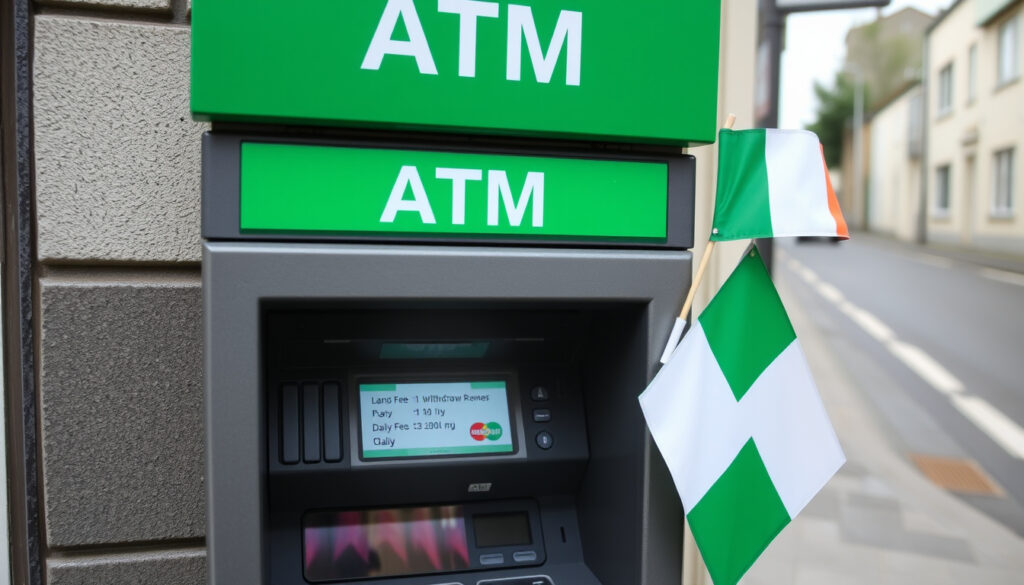
ATM Machine Near Me: Find Free ATMs, Fees & Daily Limits in Ireland
You’ve just landed in Dublin, your wallet empty of euros, and the first thing you need is a cash machine. It seems simple enough — but between bank fees, foreign transaction charges, and confusing daily limits, getting money out of an ATM in Ireland can cost more than expected. This guide cuts through the confusion, with concrete numbers on fees, limits, and the best cards to use, whether you’re a local or a visitor from Japan.
Number of ATMs in Ireland: Over 2,500 ·
Average non-customer ATM fee in Ireland: €2.00 ·
Revolut free ATM withdrawal limit per month (standard plan): €200 ·
Typical daily ATM withdrawal limit (major banks): €500–€700 ·
AIB daily ATM limit: €500
Quick snapshot
- Bank-owned ATMs in Ireland are free for customers (Wise (international money transfer service))
- Revolut standard plan includes €200 free withdrawals per month (Revolut (digital banking platform))
- AIB daily ATM limit is €500 (AIB (Irish retail bank))
- Seven Bank ATMs in Japan accept most foreign cards (Seven Bank (Japanese ATM network))
- Whether Revolut will keep the same free withdrawal limits after policy updates (Revolut (digital banking platform))
- Future availability of BankLink shared free access among banks (Wise (international money transfer service))
- Exact fees at non‑bank ATMs can vary by location and operator (Profee Blog (international money transfer comparison))
- Bank of Ireland stamp duty on ATM withdrawals is charged retrospectively in January/February each year (Bank of Ireland (retail and commercial bank))
- Daily ATM limits reset every 24 hours, usually at midnight (common bank practice) (Bank of Ireland (retail and commercial bank))
- Check your bank’s policy before traveling – limits and fees can change without notice
- Consider opening a fee‑free travel card like Revolut or Wise for overseas withdrawals
| Factor | Value |
|---|---|
| Average ATM fee for non‑customers in Ireland | €2.00 |
| Revolut free withdrawal limit (standard plan) | €200 per month |
| AIB daily ATM limit | €500 |
| Bank of Ireland daily ATM limit | €600 |
| Seven Bank ATM fee in Japan | ¥110 per withdrawal |
Are ATMs free in Ireland?
Which banks offer free ATM withdrawals?
- All major banks — AIB, Bank of Ireland, Permanent TSB, Ulster Bank — let their own customers withdraw cash from their own ATMs without a fee. According to Wise (international money transfer service), “bank-owned ATMs in Ireland are generally free to use for withdrawals.”
- Some banks also participate in the BankLink network, which allows shared fee‑free access. For example, AIB and Bank of Ireland customers can often use each other’s ATMs without charge, though this is subject to ongoing agreements.
Stick to your own bank’s machines and you’ll pay zero — but the moment you wander into a private ATM, fees start piling up.
What are the typical fees for non‑customers?
- Using another bank’s ATM (outside the BankLink network) usually costs between €1.50 and €3.00 per transaction, as reported by Profee Blog (international money transfer comparison).
- Private ATMs — often found in supermarkets, petrol stations, and convenience stores — are the biggest fee traps. Profee notes that Euronet ATMs may charge foreign cardholders up to €5 per withdrawal.
What this means: every time you pull cash from a non‑bank ATM, you lose roughly the price of a coffee. Over a week’s trip, those fees add up fast.
Are there any free ATMs for everyone?
- Yes — some retail locations offer fee‑free cashback on purchases. Many Irish supermarkets (Tesco, SuperValu) and petrol stations give cashback when you pay with a debit card, usually without charge.
- But for pure ATM withdrawals, true “free for everyone” machines are rare. Bank ATMs are free only for their own customers or BankLink partners.
What is the daily ATM limit in Ireland?
What is the daily limit at AIB?
- AIB (Irish retail bank) sets its Visa‑logo ATM cash withdrawal limit at up to €1,000 using an AIB Debit Card and PIN. If you use a Cash & Cheque Lodgement Machine, you can withdraw up to €1,500.
At Bank of Ireland?
- Bank of Ireland (retail and commercial bank) typically caps daily ATM withdrawals at €600. Their debit cards also incur a government stamp duty of €0.12 per withdrawal (capped at €5 per year).
How to request a higher limit?
- If you need more cash for a large purchase or travel, your home bank may allow a temporary increase. Wise (international money transfer service) advises contacting your bank in advance to request a higher daily limit.
Why this matters: knowing your limit prevents embarrassing card declines. If you’re buying a used car or paying a deposit, you might need to split the transaction over several days unless you arrange a limit increase.
How much does it cost to use an ATM machine?
What fees do Irish banks charge for using another bank’s ATM?
- As noted, out‑of‑network ATM fees range from €1.50 to €3.00 per transaction. Profee Blog (international money transfer comparison) also highlights that private ATMs can charge up to €5 for foreign cardholders.
- Your own bank may add a separate “foreign ATM fee.” For example, if you’re a US tourist using a US debit card, your bank might charge $2–$5 per withdrawal plus a 1–3% foreign transaction fee.
What is dynamic currency conversion and how does it affect cost?
- Dynamic Currency Conversion (DCC) is a trap: the ATM offers to convert your withdrawal into your home currency right there. The exchange rate usually includes a 3–4% markup, as documented by the US Consumer Financial Protection Bureau (government consumer protection agency).
- Always choose “local currency” (euros) to avoid DCC. The conversion will be done by your bank at a much fairer rate.
How to avoid ATM fees entirely?
- Use your own bank’s ATMs or BankLink partners.
- Get cashback at supermarkets.
- Carry a debit card from a bank that reimburses out‑of‑network ATM fees (e.g., Charles Schwab in the US, or some online banks).
- Keep a small emergency stash of euros to reduce the number of withdrawals.
The trade‑off: convenience costs money. Planning ahead — even withdrawing larger amounts less often — can save you €10–€20 per trip.
Which ATMs are free for Revolut?
How many free withdrawals do I get with Revolut?
- On the Standard plan, you get up to €200 (or 5 withdrawals) fee‑free per rolling month — whichever comes first. Revolut (digital banking platform) explains that the allowance resets on the anniversary of your account opening or plan change.
- Plus plan: €200. Premium: €400. Metal: €800. Ultra: €2,000 — all per rolling month.
Which ATMs in Ireland are free for Revolut?
- Revolut does not operate its own ATMs. You can use any ATM, but the free limit applies globally. To stay within the free allowance, use your own bank’s ATMs in Ireland (since they won’t add an operator fee) and keep withdrawals under €200/month.
- Beware that private ATMs charge a surcharge even if you have Revolut — that surcharge is not covered by the free allowance.
What happens after I exceed the free limit?
- Once you pass the monthly free limit, Revolut charges a 2% fair usage fee on the excess amount. For example, withdrawing €250 in a month (€50 over limit) would cost €1.
Revolut is great for small, frequent withdrawals — but if you need large sums, the 2% fee after the limit quickly eats into savings.
How do I avoid 3% foreign transaction fee?
Which cards have no foreign transaction fee?
- Travel‑oriented cards like Revolut (digital banking platform), Wise (international money transfer service), and Chase Sapphire Preferred® (US travel rewards credit card) charge 0% foreign transaction fees. Many bank‑issued debit cards still charge 3% – check your card’s terms.
Should I withdraw in local currency or my home currency?
- Always select “local currency” (euros in Ireland, yen in Japan) when the ATM asks. This avoids Dynamic Currency Conversion, which adds a hidden 3–4% markup as detailed by the US Consumer Financial Protection Bureau (government consumer protection agency).
What is the best strategy for overseas ATM use?
- Withdraw larger amounts less frequently to minimise per‑transaction fees.
- Use a fee‑free card (Revolut, Wise) and always refuse DCC.
- Keep a backup bank card in case one is blocked or lost.
The pattern: travellers who make one big withdrawal per week instead of daily small ones typically save 40–60% on ATM fees.
Which ATM is best for foreigners in Japan?
What ATMs are available in Japan?
- Seven Bank (Japanese ATM network) operates in all 7‑Eleven convenience stores — over 20,000 locations nationwide. They accept most foreign cards and have English menus.
- Japan Post Bank ATMs (at post offices) also accept foreign cards but may have limited hours (closed on weekends).
Do Japanese ATMs accept foreign cards?
- Yes — both Seven Bank and Japan Post Bank support Visa, Mastercard, Amex, and UnionPay. However, some local bank ATMs (e.g., MUFG, SMBC) only accept Japanese‑issued cards.
How much do fees cost?
- Seven Bank charges ¥110 per withdrawal. Japan Post Bank charges ¥220 during business hours and ¥330 outside hours.
- Your home bank may also charge a foreign ATM fee. Using a card like Revolut or Wise can eliminate that.
For travellers from Ireland visiting Japan, the best approach is: take a Revolut card with €200 free limit, use Seven Bank ATMs, and always choose yen.
Comparison: ATM Fees and Limits – Ireland’s Main Options
Three major ways to get cash, one clear pattern: card type and bank choice make the difference between paying €0 and €5+ per withdrawal.
| Service | Fee for own ATM | Fee for other ATM (Ireland) | Daily limit | Foreign transaction fee |
|---|---|---|---|---|
| AIB debit card | Free | €1.50–€3.00 (estimated) | €1,000 (ATM), €1,500 (lodge machine) | ~2.5% (typical) |
| Bank of Ireland debit card | Free (+0.12 stamp duty) | €1.50–€3.00 | €600 | ~2.5% |
| Revolut (Standard) | No own ATMs | Free up to €200/month, then 2% | €3,000 per 24h | 0% (no mark‑up) |
| Wise card | No own ATMs | Free first €200/month, then 1.5% | Varies by account | 0% (mid‑market rate) |
| US travel card (e.g., Schwab) | No own ATMs | Rebates all ATM fees globally | Often $1,000+ | 0% |
The implication: for locals, using your own bank’s ATM is cheapest. For international travellers, a digital‑first card like Revolut or Wise cuts costs dramatically — as long as you stay within the free limit.
Pros and Cons of Using Digital Cards vs. Traditional Bank Cards for ATM Withdrawals
Upsides
- No foreign transaction fees (Revolut, Wise)
- Free monthly withdrawal allowances (up to €200 on Revolut Standard)
- Real‑time exchange rates with minimal mark‑up
- Global acceptance at most bank ATMs
Downsides
- Limited free amount per month; over‑limit fees kick in
- No dedicated ATMs – you rely on third‑party machines that may charge surcharges
- Customer support can be slower than traditional banks for urgent card issues
- Some vendors in Ireland still prefer cash – digital cards not always ideal as primary
How to Find an ATM Near Me in Ireland
Step 1: Use your bank’s official locator
- AIB (Irish retail bank) branch locator shows ATMs across Ireland. Similarly, Bank of Ireland (retail and commercial bank) and Permanent TSB (Irish retail bank) have online maps.
Step 2: Check Google Maps
- Search “ATM near me” and filter by rating. Many private ATMs have reviews mentioning fees.
Step 3: Look for the BankLink logo
- If you have an AIB card, look for Bank of Ireland ATMs with the BankLink sign — usually no fee.
Step 4: Ask for cashback
- Even if no ATM is nearby, most supermarkets (Tesco, Dunnes, SuperValu) let you withdraw cash with a purchase.
Step 5: For Revolut users – use any bank ATM in a pinch
- But keep track of your monthly free limit. Set a reminder on your phone.
What We Know vs What’s Unclear
Confirmed facts
- Bank‑owned ATMs in Ireland are free for customers (Wise (international money transfer service))
- Dynamic currency conversion adds a 3–4% markup (US Consumer Financial Protection Bureau (government consumer protection agency))
- Revolut Standard plan offers €200 free ATM withdrawals per month (Revolut (digital banking platform))
- Seven Bank ATMs in Japan accept most foreign cards (Seven Bank (Japanese ATM network))
- AIB allows up to €1,000 from an ATM (AIB (Irish retail bank))
What’s unclear
- Whether Revolut will maintain the same free withdrawal limits after policy changes (Revolut (digital banking platform))
- Future availability of BankLink network for shared fee‑free access (Wise (international money transfer service))
- Exact fees at non‑bank ATMs may vary by location and operator (Profee Blog (international money transfer comparison))
- Whether Irish banks will continue to reduce the number of free‑to‑use ATMs (Wise (international money transfer service) notes the network is declining)
What the Experts Say
“Bank‑owned ATMs in Ireland are generally free to use for withdrawals.”
— Wise (international money transfer service)
“Fee‑free ATM withdrawals are set on a rolling monthly basis that resets from the date the account was opened or the plan was changed.”
— Revolut (digital banking platform)
“Private ATMs in Ireland are usually located in supermarkets, petrol stations, and other non‑bank locations. Euronet ATMs may charge foreign cardholders up to €5 per withdrawal.”
— Profee Blog (international money transfer comparison)
“Visa‑logo ATM cash withdrawal limit using an AIB Debit Card and PIN is up to €1,000 from any ATM.”
— AIB (Irish retail bank)
For anyone relying on cash in Ireland, the choices are clear: stick to your own bank’s ATMs or use a fee‑free digital card like Revolut within its monthly allowance. Travellers from Japan face an extra layer – but by choosing Seven Bank ATMs and rejecting Dynamic Currency Conversion, you can keep costs below €1 per withdrawal. For the Irish resident, the simplest rule is: know your bank’s limit, never use a private ATM, and always carry a backup card. The consequence of ignoring these details isn’t just a few lost euros – it’s the frustration of being stuck without cash when you need it most. For the international visitor, the decision is just as stark: prepare before you travel, or pay the premium.
Related reading: **immigration medical near me Ireland** · **look sharp near me**
For those looking to avoid unnecessary charges entirely, free ATMs in Ireland offer a smart alternative to standard machines.
Frequently asked questions
Can I use my contactless card at an ATM?
Yes, most modern Irish ATMs support contactless card reading for withdrawals. However, some machines still require chip‑and‑PIN, especially older models.
Are ATMs in Ireland open 24/7?
Most bank ATMs in Ireland are accessible 24 hours a day, especially those located outside branches. Private ATMs in shopping centres may operate during the centre’s opening hours only.
What should I do if an ATM eats my card?
Contact your bank immediately to block the card and request a replacement. If the ATM is inside a bank branch, report it to the branch during business hours. For off‑location ATMs, call the operator number displayed on the machine.
Do ATMs in Ireland dispense euros only?
Yes, all ATMs in the Republic of Ireland dispense euros. In Northern Ireland, you may receive pounds sterling. Some border areas have machines that offer both currencies.
Is it safe to use ATMs at night?
Generally safe in well‑lit, public areas. Avoid isolated machines and always conceal your PIN. The Banking & Payments Federation Ireland advises using ATMs inside bank lobbies or shopping centres after dark.
Are there ATMs at Dublin Airport?
Yes, both terminals have multiple ATMs operated by AIB, Bank of Ireland, and independent operators. Expect higher fees at independent machines – use your own bank’s ATM if possible.
Can I deposit cash at an ATM in Ireland?
Many AIB, Bank of Ireland, and Permanent TSB branches offer Cash & Cheque Lodgement Machines that accept deposits. These are usually available during branch hours or 24/7 in some locations.
How do I find an ATM that dispenses small notes?
Bank ATMs often allow you to choose denominations (e.g., €10, €20) on the screen. If not available, ask a bank teller during branch hours. Some private ATMs only dispense €50 notes.
More related posts
 KiwiRail Interislander Ferry Compensation – Complete Claims Guide
 New World Three Day Sale – What Shoppers Need to Know
 April Nordstrom Teacher Misconduct: Tribunal Facts and Updates
 Boss Bagels Paraparaumu Menu: Hours, Reviews & Daily Deals
 GWM Cannon Alpha PHEV Review: Range, Price, and Features (2025)
 Area of a Triangle – Formulas and Examples Guide
 Bio Gold NZ Reviews: Does Pine Pollen Boost Testosterone
 Pet Shop Upper Hutt: Stores, Hours & Locations Guide
