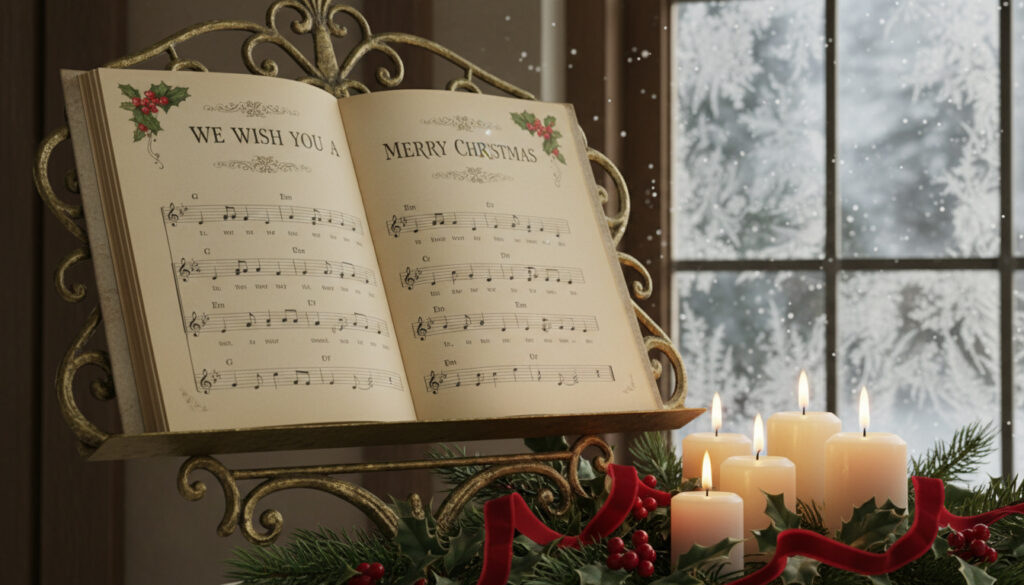
We Wish You a Merry Christmas – Lyrics, History, Meaning and Chords
Few holiday melodies permeate shopping centers, concert halls, and neighborhood caroling groups with the same ubiquity as “We Wish You a Merry Christmas.” The carol’s cheerful demand for figgy pudding and its relentless well-wishing have become sonic shorthand for the festive season in Western cultures and beyond.
Yet beneath the familiar cadence lies a history shrouded in the fog of English folk tradition. Unlike compositions with clear provenance in cathedral archives or theatrical premieres, this carol emerged from the oral traditions of the West Country, passed through generations of wassailers before ever encountering sheet music. We Wish You a Merry Christmas – History, Origins and Meaning explores this trajectory in detail.
The song exists in a unique category of cultural artifacts: recognized by billions yet authored by no one. Its journey from 16th-century tavern doorsteps to modern digital playlists illustrates how oral traditions adapt to changing cultural landscapes while retaining their core character.
What Are the Lyrics to We Wish You a Merry Christmas?
- Folk Origins: No known author; Roud Folk Song Index #230 and #9681
- Public Domain: Freely available for performance and recording
- Wassailing Roots: Emerged from traditions of demanding treats at doorsteps
- Modern Standardization: Arthur Warrell’s 1935 arrangement established the version most performed today
- Dual Celebration: Unusual among carols for blending Christmas and New Year greetings
- Regional Variants: Alternate lyrics reference beer cellars rather than figgy pudding
| First Appeared | 16th century (presumed) |
| Composer | Unknown/Traditional |
| Genre | English Christmas Carol |
| Public Domain | Yes |
| First Published | 1935 (Warrell arrangement) |
| Origin Region | Southwest England (West Country) |
| Roud Index | #230, #9681 |
| Key (Standard) | G Major |
What Is the History and Origin of We Wish You a Merry Christmas?
Who Wrote the Carol?
No individual composer or lyricist has been identified for “We Wish You a Merry Christmas.” Music historians classify it as a traditional English folk song, likely evolving through communal authorship over centuries in the West Country. The absence of early written records—particularly its omission from 19th-century collections by Davies Gilbert (1822–1823) and William Sandys (1833)—suggests it remained an oral tradition longer than many contemporaneous carols.
When Was It First Published?
The carol’s first appearance in print came relatively late. Arthur Warrell, a composer and conductor at the University of Bristol, arranged the piece for choral performance in 1935. Oxford University Press published this arrangement as “A Merry Christmas: West Country traditional song,” introducing the melody to formal musical settings. The piece gained further distribution when republished in Carols for Choirs in 1961.
The Wassailing Tradition
The carol emerged from English wassailing customs, wherein groups visited homes on Christmas Eve demanding treats from wealthy households. The lyrics’ insistent tone—”We won’t go until we get some”—reflects this practice of refusing to leave without receiving figgy pudding and cheer. This tradition temporarily vanished during Oliver Cromwell’s rule (1647–1660), when Parliament banned caroling as a “tabu custom,” causing the loss of many traditional songs before their revival in the Victorian era. Children sang it door-to-door during Victorian times in exchange for sweets.
The practice of wassailing involved groups entering households uninvited, singing loudly, and expecting food and drink as payment for blessings of good fortune. The carol’s demanding lyrics are not rude by historical standards; they represent the expected transactional nature of the custom.
What Does We Wish You a Merry Christmas Mean?
“Merry” Versus “Happy”
The carol uses “merry” rather than “happy,” a distinction carrying cultural weight. “Merry Christmas” evokes festive joy rooted in medieval English customs, while “Happy Christmas” represents a more reserved British phrasing preferred by figures like Queen Elizabeth II. American usage overwhelmingly favors “merry,” making this carol’s phrasing particularly resonant in United States holiday celebrations.
The Significance of Figgy Pudding
“Figgy pudding” refers to a traditional English pudding containing raisins, currants, or plums—not necessarily figs. In the context of wassailing, this dish represented the expected reward for carolers braving winter weather. The lyrics allude to treats given as rewards for bringing good tidings. Modern American performances sometimes substitute “fruitcake” for figgy pudding, though this alteration changes the historical reference.
Unlike sacred carols focusing on nativity themes, this song remains resolutely secular and playful. The blending of Christmas and New Year greetings possibly represents a later addition, as January 1 became New Year’s Day in the West only after 1700.
What Are the Chords and How to Play We Wish You a Merry Christmas?
The carol follows a simple I-V-I, I-V-I, IV-V-I progression in the key of G major, making it accessible to beginner guitarists and pianists. The straightforward harmonic structure reflects its folk origins, requiring only three basic chords.
G      D       G
We wish you a merry Christmas
G      D       G
We wish you a merry Christmas
C      D       G
And a happy New Year!
Guitarists typically employ a down-down-up-up-down-up strumming pattern, though the interpretation remains adaptable to various styles. Hymnary archives document numerous harmonic variations suitable for choral and congregational singing.
Warrell’s original 1935 arrangement used “I wish you a merry Christmas” rather than the modern “we.” Performers should verify which version their ensemble intends to use before rehearsal.
When Did Key Moments in the Carol’s History Occur?
- 16th century: Presumed emergence in southwest England as folk tradition.
- Early 18th century: First recorded greeting “a merry Christmas and a happy New Year” appears in print.
- 1830s: Mummers sing related variant referencing “a cellar full of beer.”
- 1858: Charlotte Yonge’s story The Christmas Mummers documents the pantry/beer variant.
- 1935: Arthur Warrell arranges and performs the piece with the University of Bristol Madrigal Singers; Oxford University Press publishes the sheet music.
- 1961: Republished in Carols for Choirs, reaching wider choral audiences.
- 1971: Folk versions recorded by traditional singers including George Dunn.
- 1980s: Gramophone recordings preserve early 20th-century performance practices.
- 1992: New Oxford Book of Carols describes the piece as “English traditional.”
What Is Known and What Remains Uncertain About the Carol?
Established Facts
- The carol emerged from English wassailing traditions
- Arthur Warrell created the first widely distributed arrangement in 1935
- The greeting “a merry Christmas and a happy New Year” dates to the early 18th century
- The song appears as Roud Folk Song Index #230 and #9681
- Caroling was banned under Oliver Cromwell from 1647–1660
Remaining Questions
- The exact date and location of the carol’s first composition
- The original melody before Warrell’s arrangement
- Whether the New Year reference was present in earliest versions
- The specific individuals responsible for lyrical variations
- How the song survived the Cromwellian suppression of carols
Why Has This Carol Remained Culturally Significant?
The carol’s endurance stems from its reflection of wassailing’s social function. British music traditions maintained the practice of community singing during the Victorian revival, embedding the song in secular holiday celebrations. Its accessibility—requiring no complex vocal technique or instrumental accompaniment—allows spontaneous performance in homes, schools, and public spaces.
The dual-purpose greeting, covering both Christmas and New Year, extends its seasonal utility beyond December 25. We Wish You a Merry Christmas – History Lyrics Meaning examines how this flexibility contributed to its global adoption. The song now serves as a closing number for concerts and a staple of shopping center soundtracks, representing luck-bringing traditions in modern commercial contexts. The dual-purpose greeting, covering both Christmas and New Year, extends its seasonal utility beyond December 25, much like the diverse Lemon and ginger tea benefits can offer comfort throughout the year.
What Do Music Historians Document About This Carol?
Documentary evidence reveals a gap between the carol’s presumed antiquity and its written record. Nineteenth-century antiquarians like Davies Gilbert and William Sandys collected hundreds of regional carols yet missed this particular tune entirely. The Library of Congress archives preserve early 20th-century recordings that demonstrate the melody’s evolution before Warrell’s standardization.
The carol is secular and jocular, blending Christmas and New Year greetings—uncommon among carols, possibly a later addition since January 1 became New Year’s Day in the West only after 1700.
— Musicological analysis, Music Collection
It gained widespread popularity through Arthur Warrell’s 1935 choral arrangement, published by Oxford University Press.
— Historical documentation, Wikipedia
How Can We Understand This Carol Today?
“We Wish You a Merry Christmas” represents a living bridge between medieval English customs and contemporary global celebrations. Its anonymity proves no obstacle to its power; rather, the collective authorship allows each generation to adapt the song while maintaining its essential character as a demand for shared celebration and sustenance. We Wish You a Merry Christmas – History, Origins and Meaning provides further exploration of how this traditional English carol continues to evolve in digital age performances.
Frequently Asked Questions
Are there different versions of We Wish You a Merry Christmas?
Yes. The West Country standard demands figgy pudding, while 19th-century variants sung by mummers referenced “a cellar full of beer” and “a pocket full of money.” Some modern American versions substitute fruitcake, and Warrell’s original 1935 arrangement used “I wish” rather than “we wish.”
Why do we sing We Wish You a Merry Christmas?
The song preserves the English wassailing tradition of bringing good tidings in exchange for food and drink. Today, it serves as a secular closing carol for holiday concerts and a universal expression of seasonal goodwill.
Is “We Wish You a Merry Christmas” in the public domain?
Yes. As a traditional folk song of unknown authorship, the carol exists in the public domain. However, specific modern arrangements published after 1935 may carry individual copyrights.
What does “figgy pudding” actually contain?
Figgy pudding traditionally contains raisins, currants, or plums rather than figs. The name derives from the general category of rich English puddings, not necessarily the specific fruit.
What is the Roud Folk Song Index?
The Roud Folk Song Index is a database cataloging English-language folk songs. “We Wish You a Merry Christmas” appears as entries #230 and #9681, reflecting the various versions collected from oral tradition.
More related posts
 Free Classic Solitaire Download: Get Your Old Game Back
 What Is Today’s Wordle Answer – Puzzle #1758 Hints and Stats
 Can Dogs Eat Tomatoes? Safety & Risks Explained
 Auckland Barrister Jack Oliver-Hood Drowns at Hāhei Beach
 Hobbiton Movie Set Reviews: Worth the Tour Cost
 Bay of Plenty Death Notices – Latest Sources and Search Guide
 All Black v Wale 2025: Hi tory, How to Watch, Legend
