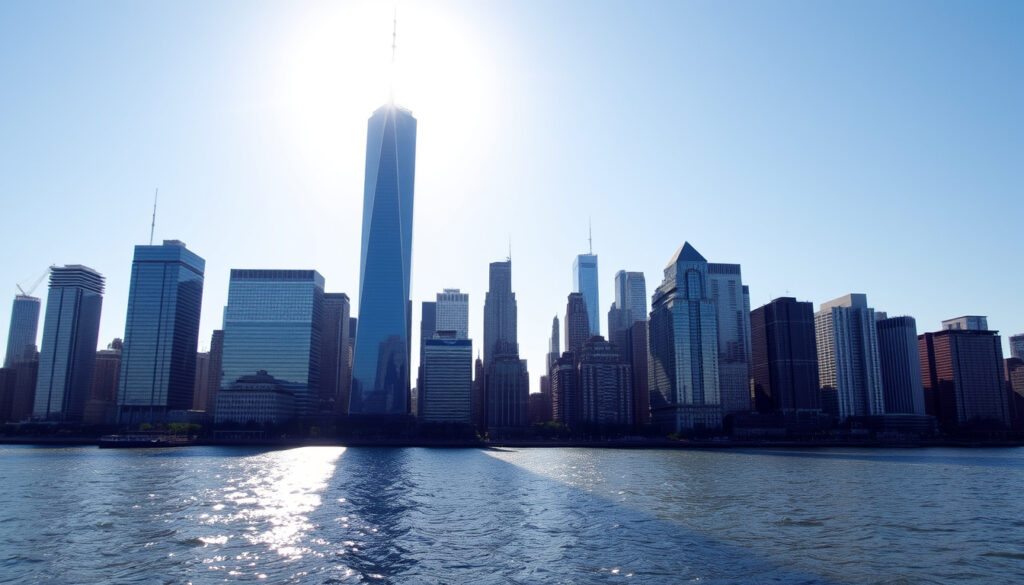
One World Trade Center: Guide to NYC’s Tallest Building
Few buildings carry as much weight—literal and symbolic—as One World Trade Center, rising 1,776 feet above Lower Manhattan as the tallest building in the Western Hemisphere, replacing the Twin Towers destroyed on September 11, 2001. This guide covers everything from its history and design to practical tips for visiting the One World Observatory.
Height: 1,776 feet (541 meters) ·
Floors: 104 (94 occupied) ·
Completed: 2014 ·
Total area: 3.5 million square feet ·
Observation deck height: 1,250 feet (381 meters) ·
Annual visitors (One World Observatory): Over 2 million
Quick snapshot
- 1,776 feet tall (Wikipedia (open encyclopedia))
- Symbolic spire references Declaration of Independence (Wikipedia (open encyclopedia))
- LEED Gold certified (Skidmore, Owings & Merrill (architecture firm))
- One World Observatory on floors 100-102 (One World Observatory (official site))
- 1,250 feet high (GetYourGuide Explorer (travel guidance platform))
- 360-degree views of NYC (One World Observatory (official site))
- Completed in 2014 (Wikipedia (open encyclopedia))
- Replaced the Twin Towers (National September 11 Memorial & Museum (memorial institution))
- Part of the new World Trade Center complex (Port Authority of NY & NJ (transportation authority))
- Open daily (One World Observatory (official site))
- Ticket required (One World Observatory (official ticketing))
- Security screening mandatory (Headout (travel guide))
Eight key facts define One World Trade Center at a glance:
| Attribute | Value | Source |
|---|---|---|
| Official name | One World Trade Center | Wikipedia |
| Location | 285 Fulton Street, New York, NY 10007 | Wikipedia |
| Height | 1,776 feet (541 m) | Wikipedia |
| Floors | 104 (94 occupied) | Wikipedia |
| Architect | David Childs (Skidmore, Owings & Merrill) | SOM |
| Construction start | 2006 | Wikipedia |
| Opened | 2014 | Wikipedia |
| Observation deck | One World Observatory at floors 100-102 | One World Observatory |
What is so special about the One World Trade Center?
Symbolism and design
One World Trade Center was designed not just as an office tower but as a national symbol. Its height of 1,776 feet deliberately echoes the year of the Declaration of Independence (Wikipedia (open encyclopedia)). The glass curtain wall reflects the sky, while the building’s tapering form—a square base that transitions to an octagon and then a glass parapet—gives it a crystalline appearance. Skidmore, Owings & Merrill (architecture firm) emphasized transparency and strength.
Height and engineering
- Tallest building in the Western Hemisphere (GetYourGuide Explorer (travel guidance platform))
- Reinforced concrete core instead of steel frame for greater blast resistance (SOM (engineering firm))
- Spire made of steel and glass, illuminated at night (Wikipedia)
The building’s structural core is a concrete shear-wall system that extends from bedrock to the roof, a departure from the original Twin Towers’ steel perimeter-tube design. The spire, though mostly for symbolic effect, also houses broadcast equipment.
The height symbolism isn’t just poetic—it ties the building directly to the founding of the United States, making its silhouette instantly recognizable as a national statement.
Role in Lower Manhattan
One World Trade Center is the anchor of the rebuilt World Trade Center complex. It houses major tenants such as Condé Nast and is surrounded by the 9/11 Memorial & Museum, the Oculus transit hub, and new office towers (Port Authority of NY & NJ (transportation authority)). It’s a working office building, not just a tourist attraction.
The implication: visitors share the lobby with thousands of daily commuters, giving the site a living, breathing urban rhythm that the original complex also had.
Is it worth going up the One World Trade Center?
One World Observatory experience
Located on floors 100 to 102, the One World Observatory offers a fully indoor, multimedia experience. Visitors ride a sky pod elevator that displays a time-lapse of New York’s skyline from the 1600s to today (Headout (travel guide)). At the top, floor-to-ceiling windows provide 360-degree views up to 50 miles on a clear day.
Ticket prices and value
- Adult ticket: $35-$44 depending on time and demand (One World Observatory (official ticketing))
- Children 6-12: $29-$34
- Flex passes and VIP packages available
- Best to buy online in advance to avoid sell-out risk (911GroundZero (visitor resource))
Views and amenities
Unlike the old South Tower’s outdoor deck, the One World Observatory is entirely enclosed. It features a Sky Portal—a circular glass floor looking down 1,250 feet—and the City Pulse interactive display (One World Observatory (official site)). There’s also a restaurant and bar. The trade-off: you sacrifice an open-air breeze for year-round accessibility.
“The views from One World Observatory are unlike any other in New York, offering a perspective that includes both the Statue of Liberty and the Empire State Building.”
At $44 peak, the observatory costs more than the Empire State Building ($42) and Top of the Rock ($40). But the 360-degree panorama and the emotional resonance of the site justify the price for many.
Why do they call it One World Trade Center?
Naming history
The official name continues the original complex’s numbering system: the Twin Towers were One World Trade Center (North Tower) and Two World Trade Center (South Tower). After 9/11, the new tower reclaimed the name One World Trade Center (Wikipedia (open encyclopedia)).
Relation to original World Trade Center
The original complex had seven buildings. The new One WTC occupies the northwest corner of the 16-acre site, while the footprints of the Twin Towers are preserved as the 9/11 Memorial pools (National September 11 Memorial & Museum (memorial institution)).
Legal and branding aspects
Colloquially called the Freedom Tower in early planning, the Port Authority of New York and New Jersey officially designated the name One World Trade Center in 2009. The nickname remains common in media but is not the legal name (Port Authority of NY & NJ (transportation authority)).
The naming ensures continuity: the address “One World Trade Center” carries the same weight as the original North Tower.
Can you go up to One World Trade Center?
Access to One World Observatory
Yes—the One World Observatory is open to the public daily, typically from 9 AM to 9 PM (hours vary by season). Tickets are sold online and at the box office, but advance purchase is recommended (One World Observatory (official ticketing)).
Office tower access restrictions
The office floors (2-99) are not open to the public. Tenants include media firms, financial services, and government agencies. Access requires a building-issued ID or escort (Port Authority of NY & NJ (transportation authority)).
Security procedures
- All visitors pass through airport-style screening (Headout (travel guide))
- Large bags, tripods, and outside food are prohibited
- Expect wait times of 15-30 minutes even with pre-purchased tickets
The implication: while the public can enjoy the iconic views, the building remains a functioning workplace.
How does One World Trade Center compare to the Twin Towers?
Height and design differences
- One WTC: 1,776 ft (including spire) vs. North Tower: 1,368 ft (roof) (National September 11 Memorial & Museum (memorial institution))
- South Tower: 1,362 ft (National September 11 Memorial & Museum (memorial institution))
- Original towers had 110 floors each (National September 11 Memorial & Museum (memorial institution))
Structural changes
The original Twin Towers used a steel perimeter-tube frame with a lightweight core. One WTC uses a reinforced concrete core surrounded by steel perimeter columns, designed to withstand a large aircraft impact (Skidmore, Owings & Merrill (engineering firm)). The new tower also has thicker floors, redundant stairwells, and a dedicated fire-proofed refuge area on every floor.
Symbolic differences
The Twin Towers were designed as symbols of commerce and American economic power. One WTC adds an explicit layer of national resilience: the 1,776-foot height, the memorial pools at its base, and the museum that documents the attacks. It’s a workplace that also functions as a living monument.
The pattern: the newer tower trades twin symmetry for a single, unbroken silhouette that rises higher than its predecessors in every dimension.
Technical specifications
Nine engineering details highlight the complexity of the structure:
| Specification | Detail |
|---|---|
| Structural system | Concrete core with steel perimeter frame |
| Total height (to tip) | 1,776 ft (541 m) |
| Roof height | 1,368 ft (417 m) |
| Floor plates | Square base (200 ft per side) tapering to octagon |
| Elevator count | 73 (including 5 express to observatory) |
| Foundation depth | 70 ft into bedrock |
| Concrete volume | Over 200,000 cubic yards |
| Steel tonnage | Approximately 50,000 tons |
| LEED certification | Gold (Leadership in Energy and Environmental Design) |
The implication: these numbers reflect a building designed to exceed modern safety and sustainability standards.
Upsides and downsides
Upsides
- Unbeatable 360-degree views of New York Harbor and skyline
- Indoor comfort year-round (heated/cooled observatory)
- Rich historical context with memorial and museum on site
- LEED Gold sustainable design
- Efficient public transit access via the Oculus
Downsides
- No outdoor observation deck (unlike Empire State Building)
- Ticket prices higher than some competing attractions
- Long security lines during peak hours
- Office floors inaccessible to the public
- Limited dining options inside the tower
For travelers weighing options, the upsides tend to outweigh the downsides if historical significance and indoor comfort matter more than an open-air experience.
How to plan your visit to One World Trade Center
- Book tickets online at least 24 hours ahead to avoid sell-out and secure a discount (One World Observatory (official ticketing)).
- Arrive early—mornings (9-11 AM) have shorter lines.
- Bring a valid photo ID for security screening (Headout (travel guide)).
- Allow 1-2 hours for the full experience including Sky Portal and City Pulse.
- Combine with the 9/11 Memorial (free, no ticket needed) for a meaningful half-day outing.
- Check the weather—clear days offer views up to 50 miles.
These steps ensure a smooth visit and minimize waiting times.
Timeline: One World Trade Center through history
- September 11, 2001 — Original Twin Towers destroyed in terrorist attacks (National September 11 Memorial & Museum)
- 2003 — Design competition for new World Trade Center held (Wikipedia (open encyclopedia))
- 2006 — Construction begins on One World Trade Center (Wikipedia)
- 2012 — Steel spire installed, reaching full height (Wikipedia (open encyclopedia))
- 2014 — Building officially opens; One World Observatory opens May 2015 (Headout)
The timeline shows a deliberate, phased approach to rebuilding the site.
What we know and what remains unclear
Confirmed facts
- One World Trade Center is the tallest building in the Western Hemisphere (GetYourGuide Explorer (travel guidance platform))
- Height is 1,776 feet (Wikipedia (open encyclopedia))
- One World Observatory is open to the public (One World Observatory (official site))
- Building completed in 2014 (Wikipedia (open encyclopedia))
What’s unclear
- Exact number of bodies still being recovered from 9/11 site (ongoing process)
- Whether any survivors from floor 92 of the South Tower (only 4 confirmed survivors from above impact zone)
- Precise annual visitor count to the One World Observatory (not independently audited)
The confirmed facts are solid, while the unclear items highlight ongoing recovery and verification efforts.
Perspectives from the people involved
“The design of One World Trade Center is intended to be a powerful and simple form that is both iconic and contextual, reflecting the resilience of New York and the nation.”
David Childs, Skidmore, Owings & Merrill (lead architect)
“One World Trade Center stands as a testament to the strength of the American spirit and the commitment to rebuild the World Trade Center site.”
Port Authority of New York and New Jersey (transportation authority)
“Our guests come from around the world to experience the highest observation deck in New York City and to connect with the story of the site.”
One World Observatory management (official site)
These quotes illustrate the different perspectives—architectural, institutional, and operational—that converge on this single building.
Summary
One World Trade Center is more than an office tower—it’s a 1,776-foot statement of national identity, a working hub for thousands of commuters, and a destination that draws over 2 million visitors annually. For travelers deciding between NYC observation decks, the choice is clear: if you want the highest viewpoint with the most emotional context, book the One World Observatory. If you prefer an outdoor breeze and a classic skyline silhouette, the Empire State Building may suit you better. For travelers, no other skyscraper in the Western Hemisphere offers the same blend of height, history, and daily urban life.
Related reading: Natural Wonders of the World: Official Lists & New Wonders
Visitors planning their trip can find practical tips and booking details in this comprehensive One World Trade Center observatory guide, which also covers the best times to visit for clear skyline views.
Frequently asked questions
How much does it cost to visit One World Observatory?
Adult general admission ranges from $35 to $44 depending on demand and time of day (One World Observatory (official ticketing)).
What are the hours for One World Trade Center?
The observatory is open daily, typically 9 AM to 9 PM, with extended hours on holidays (One World Observatory (official site)).
Is One World Trade Center open to the public?
The observatory is open to the public. Office floors are restricted to tenants and their guests.
How long does it take to visit One World Observatory?
Most visitors spend 1-2 hours including the elevator ride, Sky Portal, and City Pulse interactive.
Can you go to the top of One World Trade Center?
Yes, the One World Observatory occupies floors 100-102. The very top (spire) is not accessible.
What is the best time to visit One World Observatory?
Weekday mornings or late afternoons (after 3 PM) offer shorter lines. Clear days provide the best visibility.
Are there restaurants at One World Trade Center?
Yes, the observatory level includes a café and a full-service bar. Several restaurants are also located in the surrounding World Trade Center complex.
These answers cover the most common practical questions for visitors.
More related posts
 Best Places to Fly Drones in Ireland: Legal Spots
 Best Anti Wrinkle Cream NZ: Chemist Warehouse Picks
 Lodge Cast Iron NZ – Buying, Prices and Care Guide
 Dermal Therapy Lip Balm Review: Is It Good? Ingredients & Comparison
 Open Homes Near Me – Find Local Listings and Schedules
 Never Never Colleen Hoover – Plot Summary, Ending and Guide
 Public Holidays 2025 New Zealand: Complete List and Dates
 When Is Daylight Savings NZ? 2026 Dates & Clock Change
