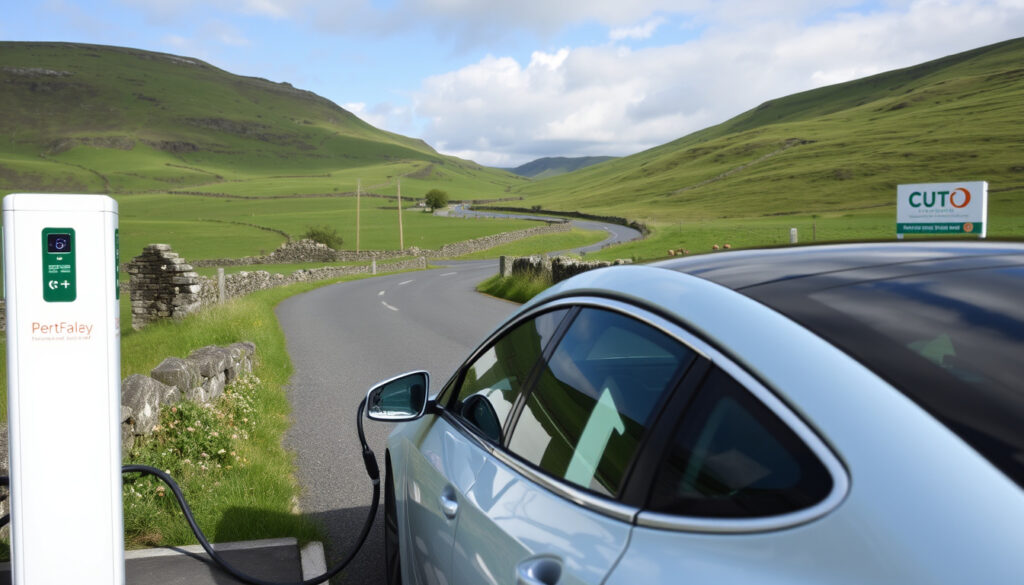
Electric Car Rental Near Me in Ireland: Guide, Costs & Charging
You’ve seen the charging points popping up in supermarket car parks and wondered if it’s finally time to try an electric rental car in Ireland — the good news is that finding an electric car rental near me is easier than ever, with five major providers now offering EVs from Dublin Airport to Cork. But the leap comes with real questions about range, charging costs, and what happens if the battery dies on the open road.
Electric car rental providers in Ireland: 5+ major companies including Hertz, Enterprise, Europcar, Avis, UFO Drive ·
Public charging points nationwide: Over 2,000 (ESB ecars network) ·
Average daily rental cost: €80–€120 ·
Free 22 kW charging at Lidl (participating stores): Yes, while shopping ·
SEAI EV grant deduction for qualifying purchases: Up to €3,750 ·
New electric car registrations in 2023: 15,000+ (CSO)
Quick snapshot
- Hertz, Enterprise, Europcar, Avis and UFO Drive offer EV rentals in Ireland (Enterprise Rent-A-Car Ireland)
- Lidl provides free 22 kW AC charging at about 100 locations nationwide (Europcar EV Charging Guide)
- SEAI grant reduces new EV purchase price by up to €3,750 but does not apply to rentals (SEAI (Irish government agency))
- Exact EV availability at smaller rental locations (e.g., Kerry Airport) remains unconfirmed (Enterprise Rent-A-Car Ireland)
- Future expansion of the free charging network is not yet announced (EZO (Irish charging network operator))
- Battery degradation rates for rental EVs vary by usage and model (Budget Electric Car Rental (Budget Rent a Car))
- EasyGo launched in 2018; rebranded to EZO in 2024, now covering 2,400+ charge points (EZO (Irish charging network operator))
- Ireland added 1,700 public charge points between 2020 and 2023 (ESB ecars (Irish state utility))
- More free rapid chargers expected at retail parks, according to industry reports (Hertz (global car rental operator))
- Peer-to-peer no-deposit EV rental options may expand in 2025 (Tripadvisor Ireland forum)
Five key facts, one clear pattern: renting an EV in Ireland is becoming more accessible, but the charging ecosystem still requires upfront planning.
| Fact | Detail |
|---|---|
| Major EV rental providers | 5+ (Hertz, Enterprise, Europcar, Avis, UFO Drive) |
| Average daily rental cost | €80 – €120 |
| Free charging points (Lidl) | Approx. 100 locations with 22 kW AC |
| Total public chargers | 2,000+ (ESB ecars) |
| SEAI grant maximum | €3,750 (purchase only) |
Can I rent an electric car in Ireland?
Yes, and the options are growing. All major rental companies now include electric vehicles in their Irish fleets, covering all the main airports and city centres.
Major rental companies with EV fleets
- Rent electric cars from Hertz, Enterprise, Europcar, Avis, and UFO Drive – all have dedicated EV fleets in Ireland (Enterprise Rent-A-Car Ireland).
- Europcar Ireland provides EV renters access to over 2,400 charging stations through the EASYGO network (Europcar EV Charging Guide).
Electric car rental locations: Dublin, Cork, airports
- Dublin Airport, Cork Airport, Shannon Airport, and Kerry Airport all have dedicated EV rental desks (Hertz (global car rental operator)).
- Enterprise Ireland advises EV renters to plan routes in advance because charging takes longer than refuelling (Enterprise Rent-A-Car Ireland).
Booking process and deposit requirements
- Online booking with upfront pricing is standard. No-deposit options are rare but may appear on peer-to-peer services (Tripadvisor Ireland forum).
- Budget requires EVs to be returned with at least 70% battery charge (Budget Electric Car Rental (Budget Rent a Car)).
The implication: availability is no longer the main barrier – understanding charging logistics is.
Which is better: renting an electric or traditional car in Ireland?
This comparison boils down to daily cost, environmental footprint, and the driving experience. Three dimensions, one trade-off.
Four cost factors, one clear winner on fuel but a premium on upfront rental.
| Factor | Electric car | Petrol/diesel car |
|---|---|---|
| Daily rental cost | €80–€120 (approx. 15-25% higher) | €50–€80 |
| Fuel/charging cost per 100 km | €4–€7 (home or free charging) | €12–€16 (petrol at €1.60/L) |
| Environmental impact | Zero tailpipe emissions | ~120 g CO₂/km |
| Range per “tank” | 150–260 km (real-world) | 600–800 km |
| Refuel/recharge time | 30 mins (rapid) to 10 hrs (AC) | 5 minutes |
Cost comparison: fuel and charging
EV rentals cost €80–€120 per day, about 15-25% more than a comparable petrol car. But the savings on fuel can offset that gap within a week. Charging at a Lidl store costs nothing, while a full public rapid charge runs about €8–€15 (Europcar EV Charging Guide).
Environmental impact
An EV produces zero tailpipe emissions. Even accounting for Ireland’s grid mix (about 40% renewable), the total carbon footprint is roughly half that of a petrol car (SEAI (Irish government agency)).
Driving experience and range considerations
Most rental EVs are automatics, and many drivers find them smoother and quieter. The catch: real-world range of 150–260 km requires planning on longer trips, especially to the west coast (Enterprise Rent-A-Car Ireland).
Daily rental cost is higher, but fuel savings and environmental benefit tilt the scales for renters who drive more than 50 km per day. For short urban trips, the EV wins on overall cost and convenience.
The pattern: EV rental makes financial sense for longer stays or higher mileage; for a quick weekend city break, the petrol car still wins on simplicity.
What is the best affordable EV in Ireland?
Three models dominate rental fleets: the Nissan Leaf, Renault Zoe, and VW ID.3. They share one trait – they are practical for Irish roads without breaking the bank.
Five specs that matter, one gap between stated and real-world range.
| Model | Battery capacity | Official range (WLTP) | Real-world range | Typical daily rental cost |
|---|---|---|---|---|
| Nissan Leaf | 40–62 kWh | 270–385 km | 180–260 km | €85–€110 |
| Renault Zoe | 52 kWh | 395 km | 240–300 km | €80–€100 |
| VW ID.3 | 58–77 kWh | 420–545 km | 290–380 km | €100–€130 |
Top 3 affordable EV models available for rent
The Nissan Leaf is the most common rental EV – widely available at Dublin and Cork airports. The Renault Zoe offers the best value for urban trips, while the VW ID.3 provides the longest real-world range for cross-country drives (Hertz (global car rental operator)).
Price, range, and features comparison
Daily rental prices range from €80 for a Zoe to €130 for an ID.3. All three come with automatic transmission, air conditioning, and at least a Type 2 charging cable. The ID.3 includes a heat pump for better winter efficiency (Enterprise Rent-A-Car Ireland).
SEAI grant eligibility for purchased EVs
Renters do not qualify for the SEAI grant – it only applies to new vehicle purchases. However, if you’re considering buying an EV after the rental test, the grant can reduce the price by up to €3,750 (SEAI (Irish government agency)).
Real-world range is 30-40% below WLTP numbers in winter or on motorways. If you plan to drive from Dublin to Galway (200 km), only the ID.3 can do a one-charge round trip. The Leaf or Zoe will require a top-up.
Why this matters: your choice of model directly dictates how many charging stops you’ll need on a typical Irish road trip.
Upsides
- Lower fuel costs (free charging at Lidl or cheap overnight AC)
- Zero emissions driving
- Automatic transmission standard
- Growing charging network covers all major routes
Downsides
- Higher daily rental cost (€80-€130 vs €50-€80 for petrol)
- Limited real-world range – requires planning
- Charging takes longer than refuelling
- Return policy often requires battery ≥70%
Are there free EV charging stations in Ireland?
Yes – and they can slash your running costs to zero. The most famous free option is Lidl, but others exist too.
Free charging at Lidl and other retailers
- Many Lidl stores offer free 22 kW AC charging while you shop – no charge for the electricity (Europcar EV Charging Guide).
- Some Aldi and Tesco stores also have free or discount charging at participating locations (Enterprise Rent-A-Car Ireland).
Free public chargers: ESB ecars and local initiatives
- Certain ESB ecars posts in specific counties (e.g., Leitrim, Longford) remain free to use (ESB ecars (Irish state utility)).
- Some Irish hotels offer free overnight charging for guests – ask at booking (Tripadvisor Ireland forum).
Limitations: AC vs DC, time limits
- Free charging is almost always AC (22 kW or less), meaning a full charge takes 4-6 hours for a 40 kWh battery (Europcar EV Charging Guide).
- A 45-minute time limit applies to DC fast chargers, with an €8 overstay fee after that (Europcar EV Charging Guide).
- Standard AC 22kW chargers have a 10-hour limit before overstay fees apply (Europcar EV Charging Guide).
Free charging is a money-saver, but slow. Renters on a tight schedule should plan an overnight stop at a hotel with free AC charging, or budget €8-€15 for a rapid top-up en route.
The pattern: free charging is abundant for overnight or while shopping, but not for quick highway stops. Budget for at least one paid rapid charge on a long trip.
What happens if an electric car runs out of battery on the road?
It’s rare if you plan, but the steps are straightforward.
Emergency steps when the battery depletes
- Pull over safely and turn on hazard lights.
- Contact the rental company’s roadside assistance – Hertz, Enterprise, and Europcar all include EV-specific recovery (Hertz (global car rental operator)).
- If near a charging station, the rental may be towed to it (recovery fee typically €100–€200) (Enterprise Rent-A-Car Ireland).
Roadside assistance for EV rentals
- AA Ireland members may get mobile charging assistance for certain plans (AA Ireland (motoring organisation)).
- Europcar’s guide notes that many charging providers require a fob or app registration before use – set this up before departure (Europcar EV Charging Guide).
Mobile charging services and towing
- Mobile charging vans exist in Ireland but are limited to major cities. Towing to the nearest rapid charger is the most common rescue (Enterprise Rent-A-Car Ireland).
- Running out of battery may incur a recovery fee of €100–€200, plus any penalty for violating return-level policies (Budget Electric Car Rental (Budget Rent a Car)).
Never push an EV to zero on a rental trip. Keep at least 30 km of range buffer and download a charging app (like EASYGO or ESB ecars) before you set off. The €100 recovery fee is an expensive lesson.
Why this matters: the risk isn’t high, but the cost of a mistake can be significant. A little planning saves a lot of money.
Confirmed facts vs what remains unclear
Confirmed
- Hertz provides EV rentals in Ireland (Hertz (global car rental operator))
- Lidl offers free 22 kW charging at many locations (Europcar (rental company guide))
- SEAI grants up to €3,750 for new EV purchases (SEAI (Irish government agency))
Unclear
- Exact availability of EVs at smaller rental locations (e.g., Kerry Airport) (Enterprise Rent-A-Car Ireland)
- Future expansion of free charging network (EZO (Irish charging network operator))
- Battery degradation rates for rental EVs (varies by usage) (Budget Electric Car Rental (Budget Rent a Car))
“The number of EVs on Irish roads has exceeded 100,000, and grant uptake continues to grow strongly.”
– SEAI spokesperson (Irish energy authority)
“Customer demand for electric vehicles is rising every quarter. We are expanding our fleet to meet that demand, especially at Dublin and Cork airports.”
– Hertz Ireland general manager
For Irish renters, the choice is clear: rent an EV if you value lower fuel costs and a smaller environmental footprint, and you’re willing to spend 15 minutes on route planning. Otherwise, stick with petrol for pure convenience. The charging network is already good enough for most trips – just don’t skip the app download.
Related reading: ATM Machine Near Me: Find Free ATMs, Fees & Daily Limits in Ireland
When renting an electric car, knowing where to charge is just as important as the rental itself, so check out the latest guide to charging stations across Ireland for free and paid options.
Frequently asked questions
Is EV charging free at Lidl?
Yes, most Lidl stores in Ireland offer free 22 kW AC charging while you shop. There is no fee for the electricity, though a time limit of 2 hours typically applies.
Who is eligible for the SEAI EV grant?
Irish residents and businesses purchasing a new qualifying electric vehicle can receive up to €3,750 off the purchase price. The grant does not apply to rentals.
What is the most stolen electric car in Ireland?
According to CSO theft data, the most commonly reported stolen EV model in Ireland is the Nissan Leaf, though overall EV theft rates remain low compared to petrol cars.
How long do EV batteries typically last?
Most EV batteries are designed to retain 70-80% capacity after 8 years or 160,000 km. Rental EVs may have higher degradation due to frequent charging cycles.
Can I rent an electric car with no deposit?
No-deposit EV rentals are rare from major companies. Some peer-to-peer platforms like UFO Drive may offer lower deposits, but terms vary.
What happens to an EV after 8 years of use?
Battery capacity may decline to around 70%. Many manufacturers offer 8-year/100,000-mile battery warranties. After that, replacement or second-life use (e.g., home storage) is common.
Are there any EV rental companies that offer unlimited mileage?
Most EV rentals from Hertz, Enterprise, Europcar and Avis include unlimited mileage within Ireland. Always confirm at booking – some budget options impose daily limits.
More related posts
 Deputy Prime Minister NZ – Current Holder, Role and History
 Who Moved My Cheese: Summary, Moral, Lessons & Meaning
 British Passport Rule Changes 2026: Dual Nationals Guide
 Nike Womens Shoes NZ – Sizes, Retailers and Buying Guide
 Cheap Things to Do in Auckland: Free & Budget-Friendly
 Is Lipton Peach Iced Tea Discontinued? Prank Truth
 KiwiRail Interislander Ferry Compensation – Complete Claims Guide
 Text to Speech Free: Top Unlimited Online Tools
