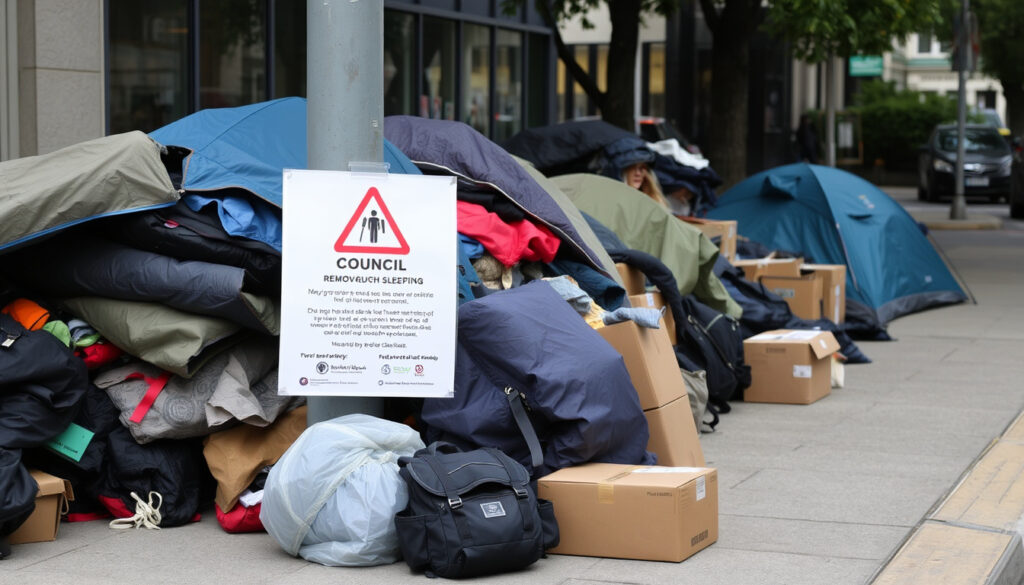
New Plymouth Rough Sleepers Face Belongings Removal Order
New Plymouth’s downtown streets have become the latest front line in New Zealand’s homelessness debate. The district council has started enforcing a bylaw that gives people sleeping rough seven days to clear their belongings from footpaths — or risk having those items seized and stored. It’s a move that has drawn sharp reactions from residents, advocacy groups, and local politicians alike.
Rough sleepers affected: more than 30 ·
Notice period: 7 days ·
Enforcement start: March 2025 ·
Council action: impound if not removed ·
Mayor statement: Neil Holdom
Quick snapshot
- NPDC enforcement started Friday, March 2025 (New Plymouth District Council)
- 30 calls related to rough sleeping received Jan–Mar 2025 (New Plymouth District Council)
- 9 of those calls referred to police (New Plymouth District Council)
- Exact number of impoundments carried out so far
- How many rough sleepers have complied with the removal notice
- What follow-up support NPDC is offering alongside enforcement
- 13 Mar 2025: Council staff began notifying rough sleepers (New Plymouth District Council)
- 14 Mar 2025: Media reported mayor’s warning on impoundment (New Plymouth District Council)
- 2023: New Plymouth’s emergency shelter closed (Newstalk ZB)
- Unremoved belongings can be seized under Local Government Act 2002 (New Plymouth District Council)
- Seized items must be stored for 14 days before disposal (New Plymouth District Council)
- NPDC still finalising seized property process as of January 2025 (New Plymouth District Council)
This table summarises the key parameters of the enforcement action.
| Field | Value |
|---|---|
| Event location | New Plymouth, NZ |
| Responsible body | New Plymouth District Council (NPDC) |
| Bylaw trigger | Street obstructions |
| Notice duration | 7 days |
| Consequence | Impoundment |
| Key figure | Mayor Neil Holdom |
How many people in Plymouth are homeless?
New Plymouth is a regional city on the west coast of New Zealand’s North Island with a population of roughly 87,000. Measuring rough sleeping in smaller cities is harder than in major urban centres, but the council’s own call data offers a snapshot. From January 1 to March 31, 2025, NPDC received 30 calls related to rough sleeping and homelessness (New Plymouth District Council). Nine of those were serious enough to be referred to police (New Plymouth District Council). That means roughly one in three contacts with the council’s homelessness response team ended with police involvement over a three-month window.
Local rough sleeper count
Mayor Neil Holdom has acknowledged the numbers in media interviews, though the council has stopped short of publishing a formal nightly count. What is clear is that rough sleeping is visible enough on New Plymouth’s streets to generate consistent complaints about footpath obstructions. The city’s emergency shelter closed in 2023 — a fact that critics say has directly contributed to more people sleeping outdoors (Newstalk ZB).
Demographic context
New Plymouth sits within the Taranaki region, where Maori make up roughly 13% of the population. Housing stress disproportionately affects Maori communities across New Zealand, and local advocates say the enforcement pattern in New Plymouth likely mirrors that disparity.
The enforcement action disproportionately affects the most vulnerable people on New Plymouth’s streets — those with the fewest resources to relocate their belongings or navigate council processes.
Where to sleep when homeless in the UK?
Comparisons to UK homelessness responses are instructive, though the systems differ significantly. In England, local authorities have a legal duty to accommodate anyone sleeping rough who is eligible — a framework that came under severe strain during the 2010s austerity era. Citizens Advice Bureau guidance advises anyone facing immediate rough sleeping to contact their local council housing team, a night shelter, or crisis services (Citizens Advice Bureau).
Emergency options
UK emergency responses include council emergency housing, Night Angel or Salvation Army hostels, and specialist services for specific groups such as veterans or survivors of domestic violence. The system has known shortfalls — bed availability in many cities does not match demand — but it provides a legal entitlement to at least temporary accommodation.
NZ equivalents
New Zealand’s equivalent framework is less codified for emergency accommodation, particularly in smaller centres like New Plymouth. The primary national homelessness response is through Housing New Zealand and contracted transitional housing providers. In Taranaki, options are more limited. NPDC’s own homelessness page (linked from its official site) directs people toward support services rather than providing accommodation directly (New Plymouth District Council).
What happens after 56 days homeless?
In England, after 56 days of being statutory homeless (meaning the council has accepted a duty of care), an applicant is typically escalated to a higher priority band for social housing. In New Zealand, there is no single national equivalent, but the emergency shelter system is designed to bridge people toward transitional housing and eventually long-term accommodation.
Council duties
Under New Zealand law, councils are not primary housing providers, but they do have responsibilities around public spaces and public health. NPDC’s enforcement of the Public Places Bylaw rests on the Local Government Act 2002, which gives authorised council staff the power to remove offending items if the owner ignores requests to do so (New Plymouth District Council). The bylaw targets obstructions — including belongings and structures on footpaths — that impede access to properties or public areas.
Bylaw timelines
Once council staff notify a rough sleeper of a bylaw breach, the person typically has seven days to remove belongings voluntarily. If they do not comply, council staff can seize and impound the items. Under the Local Government Act 2002, any seized property must be stored for 14 days before disposal — meaning people who miss the seven-day window still have a two-week window to reclaim belongings before they are disposed of (New Plymouth District Council).
Without a clear, published retrieval process, the 14-day storage window becomes largely theoretical for people with limited mobility and no fixed address.
What is the best thing to give a homeless person?
For people wanting to help rough sleepers in New Plymouth, the practical question of what to give is genuinely useful. Major homelessness charities generally agree on a short list of genuinely needed items versus well-meaning but counterproductive donations.
Essential items
Shelter donation guides consistently highlight the following as most requested: tarpaulins and weatherproof covers for belongings, thermal base layers (especially in New Plymouth’s cool coastal winters), sturdy socks, and non-perishable food in single-serve portions. Cash donations to registered charities remain the most flexible option, as organisations can purchase exactly what is needed (The Salvation Army).
Shelter donations
Local organisations accepting donations in the Taranaki region include the Salvation Army New Plymouth and local food banks. Volunteers who distribute items directly should check whether their local branch or shelter has a current needs list — donation patterns often shift seasonally.
Donated items that reach rough sleepers before enforcement removes them serve a real purpose; after impoundment, those same items may be gone for good.
What is the most requested item by homeless people?
Across New Zealand’s shelter network, socks emerge repeatedly as the single most requested item that people rarely receive in sufficient quantity. Feet endure constant walking on hard surfaces, and wet or worn socks create serious health risks including infection and frostbite in winter. The Salvation Army and other providers explicitly list socks as a priority donation item (The Salvation Army).
Donation priorities
Beyond socks, menstrual products, hand sanitiser, and phone charging cables rank highly in current shelter wish lists. What shelters consistently advise against: expired food, heavily worn clothing, and items requiring power or plumbing to use.
Avoid items
Well-intentioned donors often give items they no longer need, but shelters spend significant resources sorting and disposing of donations that are unserviceable. Organisations like The Salvation Army provide explicit guidance on their websites about which items are currently needed versus which create logistical burdens (The Salvation Army).
The national context: police move-on powers
The New Plymouth enforcement is unfolding against a backdrop of proposed national legislation that would significantly expand police powers over rough sleepers. The New Zealand government is amending the Summary Offences Act to give police the ability to issue “move-on” orders banning rough sleepers for up to 24 hours (Stuff.co.nz via YouTube). The proposed legislation has attracted sharp criticism from opposition parties and advocacy groups.
Police move-on orders would apply to people aged 14 and older who are rough sleeping, begging, appearing to inhabit a public space, obstructing a business, or displaying disorderly or threatening behaviour (Stuff.co.nz via YouTube). The penalty for breaching an order would be a maximum fine of $2,000 or up to three months in prison (Stuff.co.nz via YouTube). Justice Minister Paul Goldsmith described the powers as an additional tool to prevent town centres from becoming places of intimidation and dysfunction (Stuff.co.nz via YouTube). Police Minister Mark Mitchell called the move-on powers a “public safety” measure (Stuff.co.nz via YouTube).
Opposition parties have been blunt in their assessment. The Labour Party described the policy as cruel (Stuff.co.nz via YouTube). The Green Party said it amounts to punishing homelessness and poverty (Stuff.co.nz via YouTube). The Auckland Business Chamber, meanwhile, called the move-on powers a sensible and necessary step to strengthen safety in the city centre (Stuff.co.nz via YouTube). The Retail Association took a middle ground, saying the orders may provide relief for antisocial behaviour but questioned their effectiveness given the 24-hour limit (Stuff.co.nz via YouTube).
Justice Minister Goldsmith confirmed there would be a select committee process for the legislation, meaning the proposed law is not yet enacted (Stuff.co.nz via YouTube). But the direction of national policy signals a broader environment in which local enforcement actions like NPDC’s are increasingly normalised.
NPDC had not finalised its process for dealing with seized property as of July 2025. Until that process is formally published, rough sleepers who have belongings impounded may face genuine difficulty reclaiming them — even with the 14-day storage window in law.
Confirmed vs unclear
The following assessment draws a clear line between what is documented and what remains uncertain.
Confirmed facts
- More than 30 rough sleepers received removal notices in March 2025
- The notice period is seven days
- The bylaw targets street obstructions in public places
- Items not removed can be seized and impounded under the Local Government Act 2002
- Seized property must be stored for 14 days before disposal
- New Plymouth’s emergency shelter closed in 2023
- The Public Places Bylaw is active and enforceable
What’s unclear
- Exact number of impoundments actually carried out
- Compliance rate among rough sleepers who received notices
- Whether NPDC is connecting enforcement with any housing support referrals
- Whether the seized property process has been published yet
- How many rough sleepers in New Plymouth are from Taranaki versus other regions
Quotes
Council staff have begun telling rough sleepers they have to remove their belongings and structures within seven days.
— Mayor Neil Holdom, New Plymouth District Council (New Plymouth District Council Official News)
Move-on powers are an additional tool to prevent town centres from becoming places of intimidation and dysfunction.
— Justice Minister Paul Goldsmith (Stuff.co.nz)
These powers amount to punishing homelessness and poverty.
— Green Party of Aotearoa New Zealand (Stuff.co.nz)
Summary
New Plymouth’s bylaw enforcement is a small-city test case for an approach that is moving from the margins to the mainstream in New Zealand. With 30 rough-sleeping related calls in three months, nine escalated to police, and an emergency shelter closed two years ago, the council is managing a visible homelessness problem with limited tools. The seven-day removal notice followed by impoundment is legally grounded, procedurally transparent, and increasingly common across the country. For New Plymouth residents who want to help, the practical path — donating needed items, supporting local services, pushing for housing investment — remains clearer than the political one. The council’s approach may reduce the visibility of rough sleeping on city streets without addressing the underlying cause.
Related reading: Deputy Prime Minister NZ · Social Media Ban NZ
Frequently asked questions
What bylaw is New Plymouth council enforcing on rough sleepers?
NPDC is enforcing its Public Places Bylaw, which prohibits obstructions in public spaces. Rough sleepers whose belongings or structures obstruct footpaths or access to properties are in breach and can be given a removal notice.
How many rough sleepers received the belongings removal notice?
Council staff notified more than 30 rough sleepers as part of the March 2025 enforcement action, according to council data reported in local media.
What happens if rough sleepers do not remove belongings in 7 days?
Council staff can seize and impound the belongings under the Local Government Act 2002. Seized items must be stored for at least 14 days before disposal, giving people a window to reclaim their property.
Does NPDC offer homelessness support alongside enforcement?
NPDC’s official homelessness page directs people toward support services, though it is not a direct accommodation provider. Critics note the closure of New Plymouth’s emergency shelter in 2023 reduced the available referral options.
When did the belongings removal warnings start in New Plymouth?
Council staff began notifying rough sleepers on 13 March 2025, with media reporting on the enforcement action the following day.
Who is leading the rough sleepers belongings policy?
Mayor Neil Holdom announced and is overseeing the enforcement action on behalf of New Plymouth District Council.
Is the belongings removal policy specific to certain streets?
The Public Places Bylaw applies city-wide to public spaces where obstructions impede footpaths or property access. The enforcement focus appears to be on areas with consistent complaints, but the bylaw is not limited to specific streets.
More related posts
 Dyspraxia: What Is It? Symptoms, Types & Differences
 We Were Liars Cast: Full Character Guide and Mysteries Explained
 Springbok Team for Saturday – Starting XV, Captain and Changes
 Cheap Flights to Sydney from Dublin: Deals & Tips
 Natural Wonders of the World: Official Lists & New Wonders
 When Is Daylight Savings NZ? 2026 Dates & Clock Change
 Low Carb Beer NZ – Best 2025 Picks and Supermarket Guide
