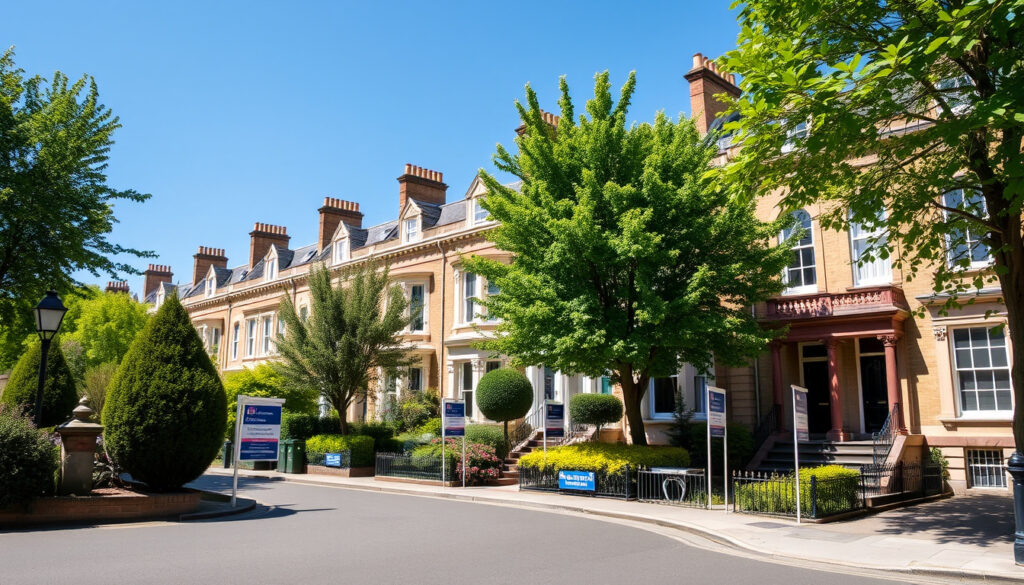
Cambridge Houses for Sale: Prices, Areas & 2026 Guide
Cambridge draws people in for different reasons: the historic colleges, the biotech jobs, the cycling culture. One thing that surprises a lot of newcomers is what it actually costs to buy property here. The median house price sits around £486,000 as of late 2025, and if you’re buying for the first time, expect to pay closer to £407,000 on average. This guide cuts through the listings to look at what you can actually afford, which neighbourhoods make sense for different budgets, and where the market looks headed in 2026.
Average house price: £486,000 (December 2025) · First-time buyer average: £407,000 · Entry-level 1-bed flats: £230,000–£320,000 · Price trend: Down 1% year-on-year
Quick snapshot
- Average house price £486,000 (Fitch and Fitch)
- First-time buyers paid £407,000 average (Fitch and Fitch)
- Price per sq metre £5,150 in H1 2026 (Investropa)
- Whether the post-St Reeves slowdown signals a broader correction
- Exact impact of upcoming rail link improvements on local prices
- Which specific villages will see biggest price shifts in 2026
- Prices down 1% over past 12 months as of early 2026 (Plumplot)
- Entry-level flats now starting around £230,000 (Investropa)
- New-build average commands £494k vs £454k for established homes (Plumplot)
- 2026 shaping up as a window for buyers who were priced out earlier
- Cambridge-to-Oxford comparison gaining urgency as costs diverge
- New-build activity may offer more entry points at lower price points
| Metric | Value | Source |
|---|---|---|
| Top Listing Sites | Rightmove, Zoopla, Savills | Market standard |
| Average House Price | £486,000 | Fitch and Fitch |
| First-Time Buyer Average | £407,000 | Fitch and Fitch |
| Price per Square Metre | £5,150 | Investropa |
| Median Price (Postcode Area) | £395,000 | Plumplot |
| 1-Bed Flat Entry Range | £230,000–£320,000 | Investropa |
| New-Build Average | £494,000 | Plumplot |
| Established Property Average | £454,000 | Plumplot |
What is the average cost of a house in Cambridge?
The most straightforward number to start with is the average house price in Cambridge: £486,000 as of December 2025, according to Fitch and Fitch. That’s down roughly 2.5% from the year before, which marks one of the first meaningful corrections the city has seen in recent memory.
First-time buyers, who tend to buy smaller properties and in less central areas, paid around £407,000 on average for the same period. The price per square metre averaged £5,150 in the first half of 2026, according to Investropa. Both figures suggest Cambridge remains expensive by national standards, but the recent softening opens the door slightly wider for buyers who previously found themselves locked out.
Looking at postcode-level data from Plumplot, the broader Cambridge postcode area showed an average price of £456,000 and a median of £395,000 between March 2025 and February 2026. The gap between average and median tells you that a cluster of higher-value properties—think Victorian terraces near the city centre or new-builds at the premium end—pulls the average up. The median is the cleaner signal for what a typical buyer actually pays.
Housing prices from Office for National Statistics
- Average price: £486,000 (Cambridge overall, Dec 2025)
- Price per sq metre: £5,150 (H1 2026 estimate)
- Postcode median: £395,000 (Mar 2025–Feb 2026)
- 12-month trend: down approximately £4,800 (-1%)
What are the best areas to buy property in Cambridge in 2026?
Cambridge’s neighbourhood structure means that “best area” depends heavily on your budget and what you’re looking for. The city essentially operates on a price gradient: the closer you are to the colleges, the river, and the train station, the more you pay. Everything beyond a certain radius drops noticeably in price.
For buyers prioritising investment potential and long-term value, the villages surrounding Cambridge—areas like Histon, Cottenham, or the settlements along the guided bus route—have consistently offered lower entry points while maintaining good connectivity to the city centre. The research notes flag “Cambridgeshire villages” as a notable search term, suggesting buyers are already looking beyond the city boundary for better value.
The most sought-after central neighbourhoods remain those with period housing stock and walkability to the university district. Properties in areas like Newnham, Perse Park, and parts of South Cambridge command consistent premiums, partly because supply rarely increases—new construction in these zones is minimal due to planning restrictions.
Poshest part of Cambridge
The title of “poshest” shifts depending on whether you’re measuring by average sale price, property condition, or local amenity access. Newnham and the streets west of Trumpington Road typically rank highest on buyer desirability surveys. The premium here isn’t just about prestige—it’s about the combination of school catchment quality, green space access, and the practical reality that Cambridge’s most desirable properties simply don’t come to market often.
Top neighbourhoods
- Newnham: Period housing, close to university, high entry cost but strong long-term retention of value
- Trumpington: Mix of Edwardian houses and newer developments, good transport links to the biomedical campus
- Villages (Histon, Cottenham, Fulbourn): Significantly lower entry price, family-friendly, commuter-friendly via guided bus
- Coleridge/Brookfields: More affordable Victorian terraces, gentrifying, good value for first-time buyers
Investment spots
For investors, the calculus is straightforward: the Cambridge station area and the biomedical campus fringe are where demand from renters is most consistent. Any property within cycling distance of these employment nodes will rent reliably, though the yield will be modest given purchase prices. The villages are a different proposition—lower acquisition cost, but renters in those areas tend to be commuters who may leave as transport patterns shift.
Types of property available
Cambridge’s housing stock includes Victorian and Edwardian terraced houses near the city centre, 1930s semis in outer neighbourhoods, purpose-built flats from the 1960s–1980s, and a growing number of new-build apartments and houses in developments like the Cambridge Biomedical Campus fringe areas. Both 2-bedroom and 3-bedroom properties are available across Cambridge and its surrounding villages—the 2-bedroom segment is well-represented by flats and small terraced houses, while 3-bedroom properties are more commonly semi-detached or terraced houses in neighbourhoods like Coleridge, Cherry Hinton, and the surrounding villages.
Property for sale in surrounding villages
Cambridgeshire villages like Histon, Cottenham, Fulbourn, Cambourne, and St Ives all have active property markets with prices meaningfully below Cambridge city itself. These areas are popular with families and commuters, and listings are available on Rightmove, Zoopla, and local estate agents.
Are house prices in Cambridge falling?
The short answer is yes, modestly. According to Plumplot, average property prices in Cambridge declined by approximately £4,800 over the twelve months leading into early 2026—a drop of around 1%. This follows a period of relatively flat growth rather than a crash, but for a city that had seen consistent upward pressure for years, even a small correction matters.
Fitch and Fitch’s data shows the average price at £486,000 in December 2025, down 2.5% from December 2024. The discrepancy between Fitch and Fitch’s larger percentage drop and Plumplot’s smaller figure likely reflects different methodologies—Fitch and Fitch may weight larger transactions more heavily. Either way, the direction is clear: Cambridge is no longer a one-way bet in the short term.
The context here matters. Cambridge’s housing market has historically been insulated from wider UK fluctuations by the concentration of high-earning residents—university staff, biotech employees, finance professionals. Their continued presence provides a floor under prices. But the recent cooling reflects broader affordability pressures: mortgage rates remain elevated, and buyers stretched at £400,000–£500,000 price points are finding their borrowing power constrained.
Market trends
- Average price decline: approximately 1% year-on-year (Plumplot data)
- December 2025 average: £486,000 (Fitch and Fitch)
- Postcode median: £395,000 (lower than the average, indicating mid-market softening)
- New-build premium intact: new properties average £494,000 vs £454,000 for established homes
2026 forecast
The 2026 outlook points to a market that is neither collapsing nor surging. Buyers who were priced out during the 2023–2024 peak may find that the window has shifted slightly in their direction. First-time buyers targeting flats under £320,000 now have more options than they did eighteen months ago. The key variable to watch is mortgage rates: if the Bank of England signals further cuts, buyer confidence could recover quickly and absorb the current inventory.
What salary do I need to buy a house in Cambridge?
This is the question that determines whether Cambridge is even a realistic option. Using the standard UK mortgage lending ratio of around 4.5× annual income, here’s what the numbers look like: for a first-time buyer purchasing at the £407,000 average, you’d realistically need a household income of roughly £90,000–£100,000 to secure a mortgage comfortably. For a median-priced property at £395,000, the required income drops to around £88,000.
Solo buyers earning the UK median wage aren’t getting a mortgage in Cambridge—not without a substantial inheritance, a partner, or creative financing. This isn’t unique to Cambridge; London’s property market left solo median earners behind years ago. But Cambridge’s high-earner concentration (biotech, academia, finance) creates a local market that functions on dual-income or high-asset-purchaser logic.
A household income of roughly £90,000 is the practical threshold for a first-time buyer purchasing at Cambridge’s £407,000 average price. Below that level, most buyers will need a significant deposit, parental support, or a property priced at the £230,000–£320,000 entry range for flats.
UK affordability benchmarks
The UK mortgage market’s affordability calculation typically uses two tests: the income multiple (usually 4.5× single income or 2.5× combined income) and the stress test (whether borrowers can afford rates 2–3% higher than the current rate). At current mortgage rates of around 5–6%, both tests compress what buyers can borrow significantly compared to the sub-3% rates of 2021–2022.
- £400,000 mortgage: requires roughly £89,000 income at 4.5× multiplier
- £486,000 mortgage: requires roughly £108,000 income at 4.5× multiplier
- Deposit requirement (15%): £60,000–£73,000 depending on purchase price
- Monthly payment estimate: £2,100–£2,600 at 5.5% on a 25-year term
Mortgage calculations
The monthly cost of servicing a Cambridge mortgage is substantial. At a purchase price of £407,000 with a 15% deposit (£61,050), you’d be borrowing £345,950. At 5.5% interest over 25 years, the monthly payment sits around £2,150. Add service charges, insurance, and maintenance, and the true monthly cost pushes toward £2,500–£2,700. For a dual-income household both earning £45,000, this is manageable. For a single earner at the UK median of £35,000, it simply doesn’t work without external support.
Is it cheaper to live in Cambridge or Oxford?
Both Oxford and Cambridge share the same basic structural problem: university towns with constrained housing supply, high-earning professional populations, and landlocked geography that makes expansion difficult. But their price dynamics differ in ways that matter for buyers weighing their options.
Oxford’s average property price historically runs slightly above Cambridge’s, though the gap has narrowed at various points. Both cities see similar premiums for central location and similar discounts for outer neighbourhoods and surrounding villages. The key variable is employment: Oxford’s economy is more oriented toward pharmaceuticals (AstraZeneca’s nearby presence), publishing, and the university itself. Cambridge’s biotech and tech sector growth has been more aggressive over the past decade, which has both driven prices higher and created more volatile demand cycles.
Oxford offers comparable cultural amenities and similar price pressures, but Cambridge’s stronger tech sector presence means more volatile demand—both a risk and an opportunity depending on where you expect to work.
Cost of living comparison
Housing aside, Oxford and Cambridge have roughly comparable everyday costs. Groceries, transport, and entertainment run within a few percentage points of each other. Where they diverge is in property-specific costs: Cambridge’s guided bus and cycle infrastructure makes car ownership less essential, which can offset some of the higher property costs for households willing to live without a vehicle.
Housing vs other cities
Compared to London, both cities offer meaningfully lower property prices while maintaining access to high-paying employment. The London-to-Cambridge commute is practical for those based in the capital’s financial district or tech hub, with trains taking under an hour. This has made Cambridge a satellite choice for London workers who want more space, which adds demand pressure from a direction that most other UK regional cities don’t experience.
Cambridge vs Oxford: price comparison
Four cities, one clear pattern: Cambridge and Oxford sit at comparable price levels, well above the national average but below London. The table below synthesises available data on average prices and entry-level costs.
| Location | Average Price | 1-Bed Flat Entry Range | New-Build Premium |
|---|---|---|---|
| Cambridge, UK | £486,000 | £230,000–£320,000 | £40,000 |
| Oxford, UK | ~£480,000–£510,000 (est.) | ~£220,000–£310,000 (est.) | ~£35,000–£45,000 |
| London (inner) | £530,000+ | £300,000+ | Substantial |
| UK National Average | £290,000 | £150,000–£220,000 | £20,000–£30,000 |
The pattern is straightforward: both university cities command a premium roughly 65–70% above the national average. Cambridge edges Oxford on new-build activity, while Oxford edges Cambridge on cultural heritage cachet. For most buyers, the choice comes down to employment geography—which city’s job market matches their skills.
Upsides
- 2026 offers a slightly more buyer-friendly market than 2023–2024 peak
- Entry-level flats now accessible at £230,000–£320,000
- Villages provide meaningful savings for buyers with longer commutes
- Strong employment base in biotech and tech insulates prices long-term
- New-build activity may offer better-quality stock at competitive prices
- Excellent cycling and public transport infrastructure reduces car dependence
Downsides
- Average price of £486,000 still far above national average
- Solo buyers on median UK income still cannot qualify for mortgages
- Central neighbourhoods see minimal new supply due to planning restrictions
- Recent price softening could continue, creating buyer hesitation
- Higher earner concentration pushes out moderate-income residents
- Monthly costs (mortgage, service charges) remain a significant commitment
Clarity on what’s confirmed and what’s uncertain
The verified data on Cambridge’s housing market is solid for the headline numbers—prices, square metre rates, and first-time buyer averages. Where confidence drops is in forward-looking statements and granular neighbourhood-level data that doesn’t appear in national datasets.
Confirmed facts
- Average house price £486,000 (December 2025) — Fitch and Fitch
- First-time buyer average £407,000 — Fitch and Fitch
- Price per sq metre £5,150 (H1 2026) — Investropa
- Postcode median £395,000 (Mar 2025–Feb 2026) — Plumplot
- New-build average £494,000 vs £454k established — Plumplot
- 12-month price decline approximately 1% — Plumplot
What’s unclear
- Whether price softening will accelerate or stabilise through 2026
- Exact salary benchmarks for Cambridge buyers (no single verified source)
- Oxford-to-Cambridge direct price comparison (no unified verified dataset)
- Which specific villages will see biggest relative price movements
- Impact of upcoming infrastructure investments on specific neighbourhoods
What people are saying
Cambridge’s housing market remains one of the most tightly constrained in the UK outside London. The combination of a high-earning resident population and limited opportunities for expansion means prices have structural support even in periods of broader market cooling.
— Fitch and Fitch (Cambridge property market analysis)
Entry-level buyers entering Cambridge in 2026 face a market that is more accessible than it was two years ago, but still demands household incomes well above the UK median. The £230,000–£320,000 flat range represents the realistic starting point for solo buyers or lower-income households.
— Investropa (Cambridge housing price analysis)
The outlook for Cambridge house buyers in 2026
Cambridge in 2026 looks like a city at a crossroads in its housing narrative. The prices are softening modestly—a 1% year-on-year decline is not a crash, but it’s enough to change the calculus for buyers who’ve been watching from the sidelines. The average house price of £486,000 still places Cambridge among the UK’s most expensive cities outside London, but the entry-level flat market has opened up: the £230,000–£320,000 range for one-bedroom properties is accessible in a way that a £350,000-plus first-time buyer average wasn’t a few years ago.
What hasn’t changed is the income reality. The £90,000 household income threshold for a comfortable mortgage at Cambridge’s average price point filters out a significant portion of the UK workforce. This isn’t Cambridge’s fault—it’s a function of the city’s highly specialised economy. But it does mean that Cambridge’s housing affordability problem is partly self-reinforcing: the city attracts high earners, high earners compete for limited property, limited property keeps prices elevated.
For buyers who can clear the income threshold, 2026 offers a better negotiating position than 2023 or 2024. Inventory is more available, sellers are more flexible on price, and the market’s direction is uncertain enough to give buyers pause rather than urgency. The key variable is mortgage rates: a meaningful drop below 5% could shift momentum quickly given Cambridge’s deep buyer pool.
For buyers who can’t clear that threshold, the surrounding villages are where the story becomes practical. Histon, Cottenham, Fulbourn—these areas offer genuinely lower purchase prices while maintaining access to Cambridge’s employment base via the guided bus or cycling. The trade-off is time and centrality, which different buyers weigh differently. But for a city where the centre is increasingly the preserve of the affluent, the outskirts may be where Cambridge’s next generation of residents actually lives.
Related reading: Houses for Sale Ellerslie: Auckland & Wexford Listings
realtor.com, sandrinedeschaux.com, redfin.com, youtube.com, cambridgeday.com, c21revolution.com, rah.co.uk, zillow.com, zillow.com
Frequently asked questions
What devalues a house the most?
The most significant value reducers for any property are structural problems (subsidence, Japanese knotweed, damp), negative local planning decisions nearby, high crime rates, noisy neighbours, and proximity to major road infrastructure or flight paths. In Cambridge specifically, properties with short leases or those in buildings with outstanding service charge disputes can see meaningful discounts.
What is the hardest month to sell a house?
In the UK, December is typically the slowest month for property sales, followed by January. The market picks up in spring, peaks around May–June, and then gradually slows through autumn. Summer holidays and the Christmas period both reduce buyer activity.
Who is the richest person in Cambridge?
The richest residents of Cambridge tend to be founders or senior executives in biotech and life sciences companies, given the city’s concentration of those sectors. Specific individuals aren’t publicly listed, but the wealth is concentrated in sectors like pharmaceutical development and proprietary trading.
Where to find Cambridge houses for sale on Rightmove?
Rightmove, Zoopla, and Savills are the primary listing platforms for Cambridge properties. Searching by postcode (CB1–CB5 covers the main city area) or by specific neighbourhoods like Newnham, Trumpington, or Histon will yield the most relevant results. All three platforms allow filtering by price, property type, and number of bedrooms.
Is Cambridge property market forecast for 2026?
Current data suggests 2026 will be a modestly buyer-friendly year. Prices have softened approximately 1% year-on-year as of early 2026, and inventory is more available than during the 2023-2024 peak. The key risk is that mortgage rates remain elevated at 5-6%, which constrains borrowing power. If the Bank of England signals further rate cuts, buyer confidence could recover quickly and absorb current inventory, potentially reversing the modest softening seen in late 2025.
What salary do I need to buy a house in Cambridge?
Using the standard UK mortgage lending ratio of around 4.5× annual income, a first-time buyer purchasing at Cambridge’s £407,000 average price requires a household income of roughly £90,000–£100,000 to secure a mortgage comfortably. For a median-priced property at £395,000, the required income drops to around £88,000. Solo buyers earning the UK median wage cannot realistically get a mortgage in Cambridge without substantial inheritance, a partner, or creative financing structures.
Is it cheaper to live in Cambridge or Oxford?
Oxford and Cambridge share similar structural problems—constrained housing supply, high-earning professional populations, and landlocked geography. Oxford’s average property price historically runs slightly above Cambridge’s, though the gap has narrowed at various points. The key difference is employment: Oxford’s economy is more oriented toward pharmaceuticals and publishing, while Cambridge’s biotech and tech sector growth has been more aggressive, driving higher peak prices but also more volatile demand cycles.
More related posts
 Raspberry and White Chocolate Muffins Recipe (Easy & Delicious)
 Wellington Phoenix vs Sydney FC: H2H, Stats & Prediction
 Kids Roller Skates NZ: Best Prices, Brands & Buying Guide
 Who Moved My Cheese: Summary, Moral, Lessons & Meaning
 The Rest Is Politics US: Hosts, Rankings, and Podcast Guide
 Things to Do on Waiheke Island: Free & Paid Activities
 Kaspersky Promo Codes: Best Discounts & Verified Coupons
 Where’s Charlie Lambton Quay: Menu & Hours
