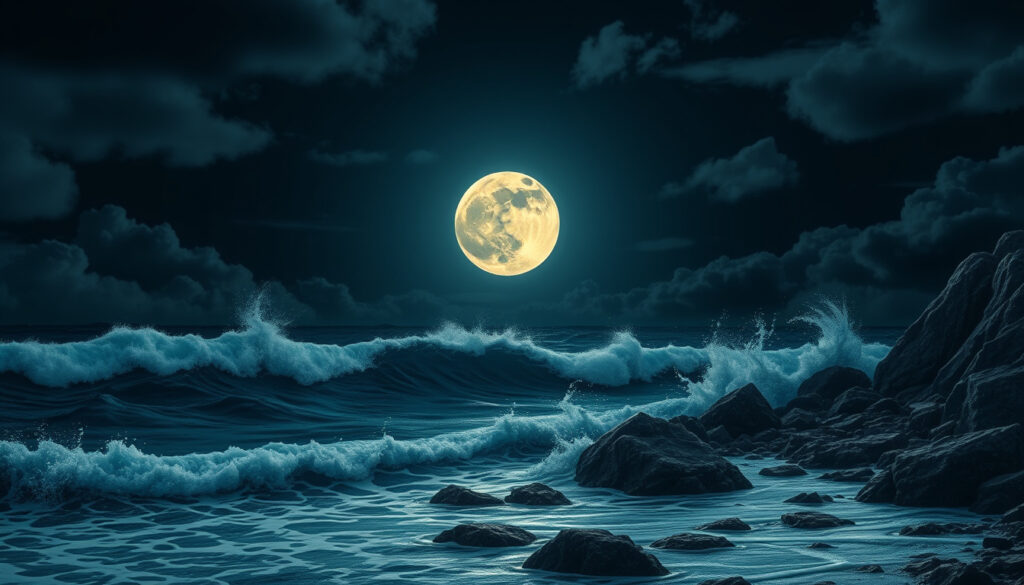
Rona and the Moon: Māori Legend Explaining the Tides
There’s a woman in the night sky, and she’s not a constellation or a satellite — she’s Rona, a figure from Māori legend who got so fed up with stumbling in the dark that she cursed the moon itself. Her story, passed down through generations, doesn’t just explain why the moon has a face; it also ties together human emotion, the tides, and a whole system of lunar knowledge that Māori have used for centuries.
Official educational resource: Careers NZ booklet (PDF) hosted on careers.govt.nz · Planetarium show: Full-dome adaptation available at fddb.org · Primary school teaching tool: Twinkl story cards used in New Zealand classrooms
Quick snapshot
- Rona is a woman who cursed the moon after stumbling in the dark (Tāhuhu Career Practice Hub – The magic of myths)
- The legend is used to explain the tides (Tāhuhu Career Practice Hub)
- The story appears in multiple official New Zealand resources (e.g. Te Ara Encyclopedia of New Zealand)
- Exact iwi origin of the story (Otago Museum – Regional variation)
- Variations in details across different versions (DigitalNZ – Regional variation)
- Whether Rona is a historical figure or purely myth (TeacherTalk – Early childhood blog)
- The lunar month lasts 29.53 days (Te Papa – Maramataka nights)
- Maramataka (Māori lunar calendar) guided fishing, planting, and harvesting (Museums Wellington – Moon phases)
- The moon influences tides, making Rona’s legend resonate with practical knowledge (Museums Wellington) (Te Papa – Maramataka nights)
- Classroom resources like Twinkl story cards and Careers NZ booklets keep the story alive (Careers NZ – Educational booklet)
- Planetarium shows bring the legend to new audiences (Fulldome Database – Show adaptation)
Quick snapshot: key facts
Five essential details, one pattern: the Rona legend blends myth with natural phenomena, making it a versatile teaching tool.
| Field | Value |
|---|---|
| Myth type | Māori legend (pūrākau) |
| Main characters | Rona, Marama (the moon), Tamanui-te-rā |
| Theme | Respect for nature, consequences of anger |
| Key source | Te Ara Encyclopedia of New Zealand |
| Modern use | Planetarium shows and classroom activities |
| Lunar month length | 29.53 days (Te Papa) |
| Maramataka meaning | “Turning of the moon” (Te Ara) |
| Associated celestial event | Matariki (Māori New Year) – midwinter rising |
| Regional variation | Some iwi use Puanga instead of Matariki (DigitalNZ) |
| Educational format | Story cards, planetarium shows, careers booklet |
The pattern: the legend serves both as a cultural story and as a practical teaching tool, linking myth to observable natural cycles.
What is the legend of Rona and the Moon?
The story of Rona and Tamanui-te-rā
- Rona and her husband Tamanui-te-rā had a troubled marriage, according to the version preserved in the Tāhuhu Career Practice Hub (Government of New Zealand).
- One night, Rona needed to fetch water but the moon gave no light — she stumbled, cursed the moon, and Marama (the moon) snatched her into the sky.
The implication: the legend personalizes natural frustration — a very human reaction becomes the reason behind the moon’s phases and the tides.
How Rona cursed the moon
According to an activity on Tāhuhu’s “The Magic of Myths”, Marama became angry when Rona cursed him after falling. He pulled her and her bucket into the sky, where she remains. The pattern: anger meets cosmic power, and the result is a permanent reminder for everyone who looks up at night.
The moon’s appearance explained
In Māori tradition, the dark patches on the moon are interpreted as Rona carrying her water bucket. The story also gives an explanation for the tides — Rona-whakamau-tai, meaning Rona who controls the tides. Te Ara Encyclopedia of New Zealand (the official government encyclopedia) notes that maramataka (the lunar calendar) is closely tied to tidal movements, grounding the myth in practical knowledge.
“Rona was taken into the sky and became the personification of the moon’s control over the tides.”
— Tāhuhu Career Practice Hub, The Magic of Myths
For teachers and parents in New Zealand, the Rona story is a hook: it makes observable science — lunar phases, tidal cycles — emotionally memorable. A child who hears why Rona curses the moon will remember that the moon’s face and the ocean’s pull are connected.
Who is Rona Māori?
Rona as a female figure in Māori mythology
- Rona is a woman, not a goddess — her story is a cautionary tale, not a creation myth. The Te Ara Encyclopedia (New Zealand’s authoritative reference) places her among the many human figures in pūrākau who interact with natural forces.
- She is associated with the moon and tides, often called Rona-whakamau-tai.
Her relationship with Tamanui-te-rā
Rona’s husband is Tamanui-te-rā, a name that includes “te rā” (the sun). Their rocky marriage echoes the dynamic between sun and moon — opposites that cannot coexist peacefully. This pairing is consistent with Māori traditions of pairing celestial bodies with human stories, as seen in other legends recorded by Te Ara.
The meaning of her name
“Rona” is a common Māori name for women. In the context of the legend, it has been interpreted as “to pull” or “to be pulled,” reflecting how she was drawn into the sky. TeacherTalk (early childhood education blog) notes that the name reinforces the idea of being taken by the moon.
“Rona is the personification of human stubbornness meeting celestial power — a reminder that nature does not tolerate disrespect.”
— Careers NZ, educational booklet
Rona is neither hero nor villain — she’s a frustrated woman who speaks out of turn. That ambiguity makes her story more relatable than a pure moral fable. It’s the kind of complexity that keeps oral traditions alive across generations.
The pattern: Rona’s ambiguity makes her a more durable teaching figure than a simple moral archetype.
What is the spiritual significance of Ruru?
Ruru (morepork) in Māori mythology
- Ruru is a native New Zealand owl, known for its distinctive “morepork” call. In Māori culture, it is a nocturnal bird deeply connected to the night — and, by extension, to the moon.
- Te Ara Encyclopedia describes ruru as a guardian of the night and a spiritual messenger.
Role as a messenger of death or change
Across many iwi, the appearance of a morepork near a home is interpreted as a visit from an ancestor or a warning of significant change — sometimes death, sometimes transformation. The Otago Museum (regional cultural institution) notes that interpretations vary by iwi, but the bird is never treated as ordinary.
Connection to the night and moon
Ruru hunts under the moon, making it a natural companion to Marama. Some versions of the Rona legend include a morepork as a witness to Rona’s curse. The moon’s light and the owl’s call together create a sensory link between the story and the nocturnal environment children experience.
“The ruru is a kaitiaki (guardian) that moves between the world of the living and the spirit world.”
— Te Ara Encyclopedia of New Zealand
What this means: the morepork ties the Rona legend to the natural world, bridging myth and everyday experience.
What does it mean when a morepork visits you?
Cultural interpretations of morepork sightings
- For many Māori, a morepork sighting is a serious event. According to Museums Wellington (public museum authority), the bird is often perceived as a messenger from ancestors, particularly if it appears at night near a home.
- Some iwi view it as a guardian spirit protecting the family.
Comparison to other Māori bird omens
Unlike the pīwakawaka (fantail), which signals a visitor, or the riroriro (grey warbler), which marks the start of spring, the morepork’s visit carries heavier weight. DigitalNZ (national digital heritage platform) notes that bird omens are deeply regional, so a morepork’s meaning can shift from one iwi to another.
Modern perspectives
Today, many Māori and non-Māori alike treat morepork encounters with respect, even if they do not follow traditional interpretations. The bird’s continued presence in urban areas has sparked renewed interest in its cultural significance. TeacherTalk (early childhood educators) recommends using the morepork as a teaching tool for children to explore Māori beliefs about nature and spirituality.
If you see a morepork near your home, most Māori elders advise acknowledgement rather than fear — treat it as a sign to reflect on change rather than an omen of doom. The bird’s message is about awareness, not inevitability.
The implication: the morepork encourages reflection, not fear, making it a useful cultural touchstone for modern audiences.
How does the legend of Rona and the Moon explain the tides?
The moon’s pull on the ocean
- Today we know the moon’s gravity causes tides. The Te Ara Encyclopedia explains that Māori traditionally observed this link and codified it in the maramataka — the lunar calendar.
- The legend personifies this scientific cause as Rona’s movement on the moon: as she moves, she pulls the ocean with her.
Rona’s role in the tide cycle
Rona-whakamau-tai literally means “Rona who controls the tides.” According to Tāhuhu’s myth activity, every time Rona shifts her position on the moon, the waters below respond. This mythological cause-and-effect mirrors the actual tidal cycle, making the legend a mnemonic device for fishermen and coastal communities.
Scientific vs mythological explanation
The Te Papa (national museum of New Zealand) notes that a lunar month lasts 29.53 days, and maramataka marks nights favorable for fishing based on tide predictions. The Rona legend doesn’t contradict science — it wraps it in a story that makes tidal patterns memorable across generations.
“The maramataka reflects the turning of the moon and the relationship between lunar rhythms, tides, and fishing decisions.”
— E oho! Ngā Tohu o te Maramataka (educational video)
Science gives you the mechanism; the legend gives you the meaning. For a child learning both, the Rona story transforms a dry fact about gravitational pull into a living narrative that sticks.
What this means: the legend is a bridge between traditional knowledge and modern science, making it valuable for education.
whyevolutionistrue.com, ancient-origins.net, matariki.twoa.ac.nz, facebook.com, youtube.com
Like the legend of Rona and the Moon, the myth of Māui and the giant fish offers another profound Māori explanation of New Zealand’s landscape.
Frequently asked questions
Is the Rona and the Moon story a myth or a legend?
It is considered a pūrākau — a Māori legend that explains natural phenomena. It is not a creation myth but a story about human interaction with celestial forces.
What is the moral of the Rona and the Moon story?
The legend teaches respect for nature and the consequences of unchecked anger. Rona’s curse leads to her permanent separation from the world.
How is the Rona legend used in New Zealand schools?
Teachers use story cards, planetarium shows, and maramataka activities to combine literacy, science, and Māori cultural knowledge. Resources from Careers NZ and Twinkl are common.
What does Rona mean in Māori?
Rona is a female name that can mean “to pull” or “to be pulled,” reflecting how she was taken by the moon.
Are there different versions of the Rona story?
Yes. Different iwi have variations — some include the morepork, others focus on the bucket or the water gourd. Regional interpretations of the moon’s face also differ.
What is the connection between Rona and tides?
Rona-whakamau-tai is said to control the tides by her movements on the moon. This mirrors the scientific tidal cycle caused by the moon’s gravity.
Related reading
More related posts
 28 Years Later Reviews: Is It Good or a Flop? Critical Reception
 Power Switch New Zealand: Compare Plans & Save Money
 Small Dining Table NZ: Buying Guide for 2025
 Karen Walker Quilted Jacket – Complete Buyer’s Guide
 Wellington Phoenix vs Wrexham AFC Stats: Result & Analysis
 Cast of Aquaman 2: Full List, Role Cuts, and Box Office Facts
 Wellington Phoenix vs Sydney FC: H2H, Stats & Prediction
 Check The Warehouse Gift Card Balance Online, Phone, In-Store
