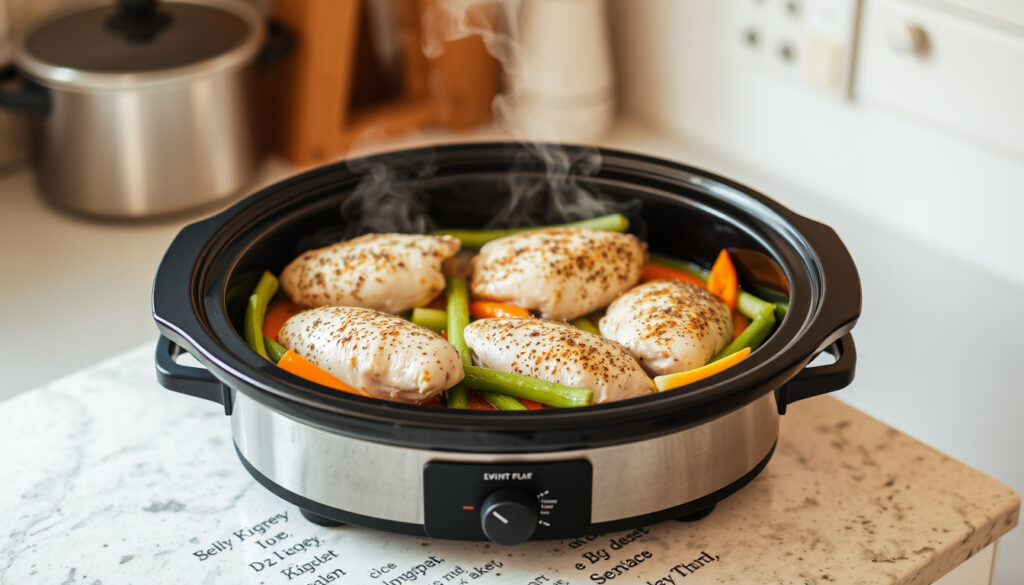
Slow Cooker Chicken Breast Recipes for Juicy Results
Anyone who’s pulled a dry, rubbery chicken breast out of a slow cooker knows the disappointment. The appliance promises set-it-and-forget-it ease, but lean poultry often pays the price. The key to consistently tender results comes down to three controllable factors: internal temperature, liquid ratio, and cooking time — and the evidence-backed numbers are surprisingly simple.
Safe internal temp: 165°F (74°C) · LOW (boneless): 3-4 hours · HIGH (boneless): 2-3 hours · Liquid per pound: ¼–½ cup
Quick snapshot
- Raw chicken is safe in slow cookers if cooked to 165°F (USDA Food Safety and Inspection Service)
- Browning is optional, not required for safety (USDA Food Safety and Inspection Service)
- USDA guidelines apply to slow cookers (USDA Food Safety and Inspection Service)
- Boneless skinless: 2–3 hrs HIGH / 3–4 hrs LOW (Bijoux & Bits)
- Bone-in: 3–4 hrs HIGH / 4–6 hrs LOW (The Cookie Rookie)
- Always use a meat thermometer (Bijoux & Bits)
- Add ¼ to ½ cup liquid per pound (Jessica Gavin)
- Avoid overcooking to prevent rubberiness (Jessica Gavin)
- Acidic ingredients help tenderize (Jessica Gavin)
- 3-ingredient: chicken + salsa + seasoning
- With vegetables: carrots, onions, potatoes
- Coconut milk: creamy, dairy-free option
Six key numbers, one pattern: the margin between juicy and ruined is narrower than most recipes admit.
| Factor | Value |
|---|---|
| USDA safe minimum internal temperature | 165°F (74°C) |
| Boneless skinless breast cooking time (LOW) | 3–4 hours |
| Boneless skinless breast cooking time (HIGH) | 2–3 hours |
| Bone-in breast cooking time (LOW) | 4–6 hours |
| Bone-in breast cooking time (HIGH) | 3–4 hours |
| Recommended liquid per pound of chicken | ¼ to ½ cup |
The implication: cooking time and liquid volume are the two levers that separate tender meat from a dry letdown.
Can I put raw chicken breast in a slow cooker?
Is it safe to cook raw chicken in a slow cooker?
- Yes — raw chicken breast is safe to cook directly in a slow cooker provided it reaches an internal temperature of 165°F, as confirmed by the USDA Food Safety and Inspection Service.
- Slow cookers operate at a low, steady heat that, given enough time, brings poultry to a safe internal temperature without requiring pre-cooking.
- The USDA explicitly states that slow cookers safely cook raw chicken when the appliance reaches 165°F in the thickest part of the meat.
Should I brown chicken before slow cooking?
- Browning is optional — it adds flavor and color but is not required for safety.
- Several recipe developers, including Fifteen Spatulas, note that skipping browning saves time and still produces safe, tender chicken.
- If you do sear, the caramelization adds depth to the final dish, but the slow cooker alone will fully cook the meat.
Browning costs about 8 minutes of skillet time but delivers richer flavor. For weeknight cooks, skipping it is a legitimate shortcut — not a safety compromise.
The pattern: raw-to-slow-cooker is safe, and browning is a flavor choice, not a safety step. The only non-negotiable is that final temperature.
How long does it take to cook chicken breast in a slow cooker?
Cooking times for boneless skinless chicken breast
- Boneless skinless chicken breast typically cooks in 2–3 hours on HIGH and 3–4 hours on LOW, according to Bijoux & Bits.
- Fifteen Spatulas reports that a single layer of boneless breasts reaches 165°F in about 3 hours on LOW.
- The Cookie Rookie gives a wider window of 3–4 hours on HIGH and 4–6 hours on LOW, reflecting variation in breast size and slow cooker performance.
Cooking times for bone-in chicken breast
- Bone-in chicken breast requires longer cooking: 3–4 hours on HIGH and 4–6 hours on LOW, per The Cookie Rookie.
- The bone acts as a heat sink, slowing the rate at which the thickest part of the meat reaches 165°F.
- Thicker cuts and crowded slow cookers push cooking times toward the upper end of these ranges.
What this means: the difference between “done” and “overdone” can be as little as 30 minutes. A meat thermometer is the only reliable tool.
Do I need to add liquid to the slow cooker with chicken breast?
How much liquid is needed?
- Liquid is recommended to prevent drying, but the amount is modest: about ¼ to ½ cup per pound of chicken, according to Jessica Gavin.
- Elizabeth Rider uses as little as 1 tablespoon of water per breast, adding ¼ cup only if the bottom of the slow cooker becomes dry.
- Bijoux & Bits recommends ½ cup stock or water per pound of chicken.
- Chicken breast does not need to be submerged — the slow cooker creates steam that circulates and cooks the meat.
What type of liquid works best?
- Broth, water, sauce, and canned soup are all common choices.
- Bowl of Delicious uses chicken broth combined with butter and lemon juice for flavor and moisture.
- According to UK Reporter, too much liquid can dilute the flavor of the finished dish, so start small and adjust.
More liquid does not mean juicier chicken. Jessica Gavin notes that excess liquid can slightly lengthen cooking time because the liquid must heat up before the meat cooks, which can push the chicken past its ideal doneness window.
The trade-off: use just enough liquid to create steam — roughly ¼ cup per pound — and avoid drowning the meat. The goal is moisture, not a poach.
How do I prevent rubbery or dry chicken in a slow cooker?
Avoiding overcooking
- Overcooking is the primary cause of rubbery chicken breast in a slow cooker, according to Glenda Embree.
- Cook on LOW for shorter times to reduce the risk of a tough texture. Embree recommends removing the chicken at 160°F, allowing carryover heat to bring it to 165°F during a 5–10 minute rest.
- A meat thermometer eliminates guesswork — the difference between 160°F and 170°F can mean the difference between tender and dry.
The role of liquid and acidity
- Acidic ingredients such as tomatoes, citrus juice, or vinegar can help tenderize chicken breast during slow cooking.
- Bowl of Delicious uses lemon juice in its cooking liquid, which both adds flavor and gently breaks down muscle fibers.
- Placing chicken breasts in a single layer without stacking, as recommended by UK Reporter, ensures even cooking and prevents some pieces from overcooking while others remain underdone.
A 30-minute window separates tender chicken from a rubbery disappointment. That’s why every tested recipe source — from Jessica Gavin to Glenda Embree — insists on a thermometer over a timer.
The pattern: rubbery chicken is almost always a symptom of overcooking, not under-seasoning. Short cook times, a modest amount of liquid, and a thermometer are the three fixes.
What are some easy and healthy slow cooker chicken breast recipes?
3-ingredient slow cooker chicken breast
- Place boneless skinless chicken breasts in a single layer in the slow cooker.
- Add ½ cup of salsa and 1 teaspoon of cumin or chili powder per pound of chicken.
- Cook on LOW for 3–4 hours or until the internal temperature reaches 165°F.
- Shred or slice and serve over rice, in tacos, or on salads.
Slow cooker chicken breast with vegetables
- Layer chopped carrots, onions, and potatoes at the bottom of the slow cooker.
- Place chicken breasts on top, season with salt, pepper, and herbs, and add ¼ cup of chicken broth.
- Cook on LOW for 4–5 hours, checking the chicken’s temperature at the 3.5-hour mark.
- The vegetables absorb the chicken juices, creating a complete one-pot meal.
Slow cooker chicken breast with coconut milk
- Combine 1 can of full-fat coconut milk, 2 tablespoons of curry paste, and 1 tablespoon of fish sauce or soy sauce in the slow cooker.
- Add chicken breasts in a single layer, spooning the coconut mixture over the top.
- Cook on LOW for 3–4 hours. The coconut milk provides creaminess without dairy and the acidity from the curry paste helps tenderize the meat.
- Serve with steamed rice and fresh cilantro.
The takeaway: these three recipes prove that the same evidence-based rules — ¼–½ cup liquid, 165°F target, low heat — work across entirely different cuisines.
Clarity: what’s confirmed and what’s still unclear
Confirmed facts
- Raw chicken breast can be safely cooked in a slow cooker if it reaches 165°F internal temperature, per USDA FSIS.
- Adding liquid helps prevent dryness, but the amount needed is modest — ¼ to ½ cup per pound is the consensus range across multiple tested recipes.
- Overcooking is the primary cause of rubbery chicken breast in a slow cooker.
- Browning is flavor-enhancing, not a safety requirement.
What’s unclear
- The optimal ratio of liquid to chicken for maximum juiciness without creating a stewed texture is not universally established — recommendations range from 1 tablespoon per breast to ½ cup per pound.
- Whether bone-in or boneless chicken breast yields juicier results in a slow cooker depends on cooking time precision and method; no authoritative comparison exists.
- The exact impact of searing before slow cooking on texture (as opposed to flavor) has not been quantified in published research.
The gap: recipe bloggers agree on the 165°F target and the importance of moderate liquid, but the precise mechanics of juiciness — especially the role of carryover cooking and resting time — remain under-explored in the slow cooker context.
Expert perspectives
“Cook poultry until the internal temperature reaches 165°F as measured with a food thermometer. This is the only reliable way to ensure that harmful bacteria have been destroyed.”
USDA Food Safety and Inspection Service
“The key to tender slow cooker chicken is to not overcook it. I take the chicken out at 160°F and let it rest. The temperature will continue to rise to 165°F during the rest, and the meat stays juicy.”
Glenda Embree, recipe developer
“Acidic ingredients like lemon juice or tomatoes can help break down the proteins in chicken, making it more tender. Combined with a modest amount of liquid, they create a cooking environment that preserves moisture.”
The implication: across regulatory and recipe-development perspectives, the same core message emerges — temperature accuracy, not time, determines success.
Summary
The evidence is consistent: juicy slow cooker chicken breast is not about complex techniques or secret ingredients. It’s about hitting 165°F at the right moment, using enough liquid to create steam but not so much that the meat stews, and letting the chicken rest before slicing. For the home cook, the choice is clear: invest in a reliable meat thermometer, stick to the low end of the cooking time range, and treat browning as a flavor bonus, not a requirement. The alternative — a dry, rubbery dinner — is entirely avoidable with these three controls.
ukreporter.uk, nzpublicnews.com, tsgcookin.com, spice.alibaba.com, lifetips.alibaba.com
Frequently asked questions
Can you overcook chicken breast in a slow cooker?
Yes. Overcooking is the leading cause of rubbery, dry chicken breast in a slow cooker. The lean meat has little fat to keep it moist, so once it passes 165°F, the muscle fibers tighten and expel moisture. Using a meat thermometer and removing the chicken at 160°F (allowing carryover heat to finish the job) prevents this.
Is it better to cook chicken breast on low or high in a slow cooker?
LOW is generally preferred for chicken breast because the gentler heat gives more margin before overcooking. HIGH can work but reduces the timing window — the difference between done and overdone shrinks from about 60 minutes on LOW to roughly 30 minutes on HIGH, according to Bijoux & Bits.
Can I use frozen chicken breast in a slow cooker?
The USDA advises against cooking frozen chicken in a slow cooker because it may spend too long in the “danger zone” (40–140°F) before reaching a safe temperature. Thaw the chicken in the refrigerator overnight before slow cooking for best results.
Do I need to flip chicken breast in a slow cooker?
No. The slow cooker’s lid traps heat and steam, cooking the chicken evenly from all sides. Flipping is unnecessary and can increase the risk of breaking the meat apart. Placing the breasts in a single layer ensures uniform cooking.
Can I add raw vegetables to the slow cooker with chicken breast?
Yes, but root vegetables (carrots, potatoes, onions) should be placed at the bottom of the slow cooker, where they are closest to the heat source and cook more thoroughly. Add quicker-cooking vegetables like zucchini or bell peppers in the last 30 minutes to prevent them from turning mushy.
How do I shred chicken breast cooked in a slow cooker?
Once the chicken reaches 165°F and has rested for 5–10 minutes, place it on a cutting board and use two forks to pull the meat apart. The residual heat and moisture make shredding easy. You can also shred the chicken directly in the slow cooker using a hand mixer on low speed.
Can I use slow cooker chicken breast in other recipes?
Absolutely. Shredded or diced slow-cooked chicken breast works well in soups, salads, tacos, sandwiches, casseroles, and pasta dishes. Because the slow cooker keeps the meat moist, it stores well in the refrigerator for 3–4 days or in the freezer for up to 3 months.
Related reading: Korean Fried Chicken Recipe · Raspberry and White Chocolate Muffins Recipe
More related posts
 Holiday Packages from NZ – Cheap, Family & All-Inclusive Deals
 All Black v Wale 2025: Hi tory, How to Watch, Legend
 Heated Rivalry Rachel Reid: Spiciness, Series Order & Age Guide
 What Is Today’s Wordle Answer – Puzzle #1758 Hints and Stats
 Best Crypto Casino Betstrike: 2026 Review
 Kaimai Road Closures Today: Live Updates & How to Check
 Vet Nurse Salary NZ: Pay, Hours & Career Guide 2025
