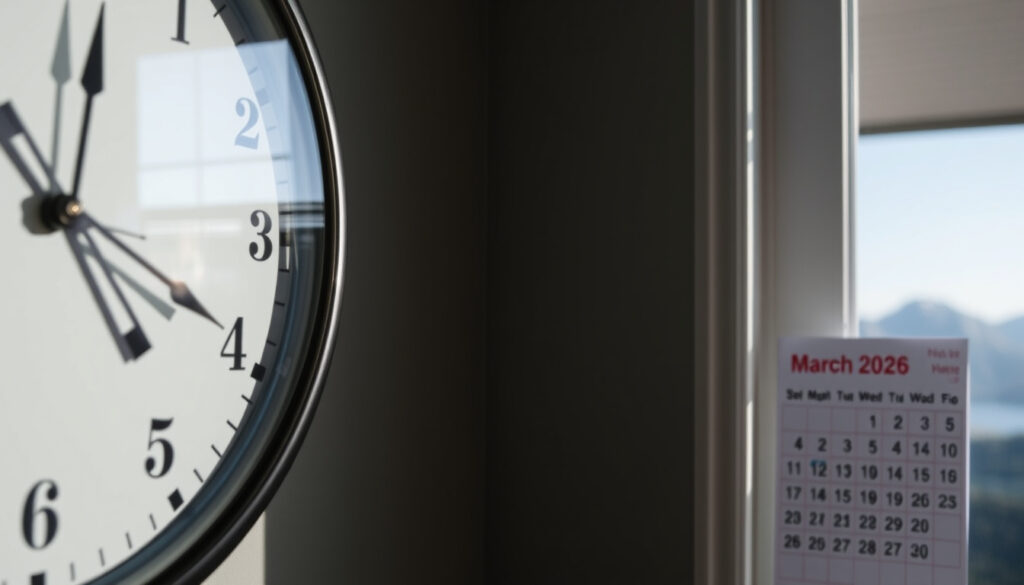
When Is Daylight Savings NZ? 2026 Dates & Clock Change
Twice a year, almost every New Zealander meets a moment of quiet confusion: the microwave clock doesn’t match the phone, and you’re not sure if you’re running early or late. Daylight saving follows a simple, predictable pattern here — forward in spring, back in autumn — but the precise dates, the direction of the change, and the impact on sleep still trip people up. This guide lays out the 2026 schedule, explains exactly what happens to your hour, and offers practical tips for adjusting smoothly.
Daylight saving starts: Last Sunday of September at 2:00 a.m. ·
Daylight saving ends: First Sunday of April at 3:00 a.m. ·
2026 start date: Sunday, 27 September 2026 ·
2026 end date: Sunday, 5 April 2026
Quick snapshot
- Clocks go forward 1 hour in September, back 1 hour in April (New Zealand Government official website)
- Whether New Zealand will ever abolish daylight saving — no active proposals as of 2025 (New Zealand Government official website)
- Current standardised dates have been in place since 2007 (Wikipedia time-in-NZ reference)
- Next clock change: Sunday, 27 September 2026 — set clocks forward (timeanddate DST reference)
Six key facts, one pattern: the schedule is fixed and predictable, yet many New Zealanders still check the exact dates every year.
| Item | Details |
|---|---|
| Clocks move forward | Last Sunday of September, 2 a.m. → 3 a.m. |
| Clocks move back | First Sunday of April, 3 a.m. → 2 a.m. |
| 2026 start | 27 September 2026 |
| 2026 end | 5 April 2026 |
| First introduced | 1927 (summer time), modern DST from 1974 |
| Current rule established | 2007 (standardised dates) |
The table confirms a pattern that has held for nearly two decades: New Zealand’s schedule is among the most stable in the world.
Do clocks go forward or back for daylight savings in NZ?
Spring forward: the start of daylight saving
- At 2 a.m. on the last Sunday of September, clocks jump forward to 3 a.m. — you lose an hour of the night.
- This follows the Southern Hemisphere pattern where spring begins in September.
Fall back: the end of daylight saving
- At 3 a.m. on the first Sunday of April, clocks fall back to 2 a.m. — the same hour happens twice, giving you an extra hour.
- The New Zealand Government confirms this schedule is fixed by law (New Zealand Government official government website).
Clock change rules for the Southern Hemisphere
- New Zealand’s pattern mirrors other Southern Hemisphere countries: forward in spring (September), back in autumn (April).
- This is the opposite of Northern Hemisphere schedules, where daylight saving runs March to November.
The implication: New Zealanders in September lose an hour they won’t get back until April, a pattern that flips the experience of relatives in Europe or North America.
Bottom line: Clocks go forward in September (lose an hour) and back in April (gain an hour). For travellers or frequent fliers, the rule is simple: September = spring forward, April = fall back.
Will we gain or lose an hour?
Losing an hour at the start of daylight saving
- When clocks go forward from 2 a.m. to 3 a.m., you effectively skip the 2 a.m. hour entirely — a net loss of one hour from your day.
- This is why the Sunday after the start often feels short and why many people report drowsiness.
Gaining an hour when daylight saving ends
- When clocks go back from 3 a.m. to 2 a.m., you relive the 2 a.m. hour — gaining a full extra hour.
- This change is generally welcomed and is easier on sleep patterns.
How the 1-hour shift affects your schedule
- The change happens at 2 a.m. (start) and 3 a.m. (end) by design — these are the quietest hours for most people, minimising disruption to work and public transport.
- Despite the early morning timing, the shift still impacts circadian rhythms, particularly the spring loss.
The catch: New Zealanders lose an hour of sleep every September and gain it back every April. The spring change is the one that catches people off guard because losing sleep is harder to adapt to than gaining it.
Is daylight savings time cancelled in New Zealand 2026?
Current status of daylight saving in New Zealand
- Daylight saving remains fully in effect across all of New Zealand in 2026, including the Chatham Islands (which observe a 45-minute offset).
- The schedule is governed by the Daylight Saving Act 1989 and subsequent orders.
No cancellation planned for 2026
- No official proposal to cancel or change DST has been enacted as of 2025 (New Zealand Government official policy website).
- The same schedule has run without interruption since the 2007 standardisation.
Global debate on abolishing DST and New Zealand’s position
- Several countries, including the European Union and some US states, have debated or partially abolished seasonal time changes.
- New Zealand has not formally joined that debate — the schedule remains stable and uncontested in public discourse.
What this means: if you see headlines about DST being “cancelled” internationally, those changes do not apply to New Zealand. The 2026 dates are locked in.
New Zealanders can plan their 2026 calendars without worrying about a last-minute cancellation. The country’s daylight saving schedule is among the most stable in the world, unchanged since 2007.
When to change clock in 2026 NZ?
Exact date to set clocks forward in 2026
- Sunday, 27 September 2026 — at 2 a.m., set your clocks forward to 3 a.m.
- This date is confirmed by multiple sources including the New Zealand Government and timeanddate (timeanddate global DST reference).
Exact date to set clocks back in 2026
- Sunday, 5 April 2026 — at 3 a.m., set your clocks back to 2 a.m.
- RNZ also notes this date in its daylight saving coverage (RNZ editorial coverage).
How to adjust your clocks automatically
- Most smartphones, computers, and smart home devices update automatically if set to the correct time zone (New Zealand Standard Time / New Zealand Daylight Time).
- Manual devices — microwaves, ovens, analogue clocks, car dashboards — will need a hands-on adjustment.
The pattern: both changes happen on a Sunday, giving you the entire weekend to adjust. But “Sunday” doesn’t mean “remember on Monday” — set a phone reminder for Saturday evening.
Do I lose an hour of sleep with daylight savings time?
Why you lose an hour in spring
- When clocks spring forward from 2 a.m. to 3 a.m., the 2 a.m. hour disappears. If you normally sleep until 7 a.m., your alarm will ring an hour earlier by the clock, effectively cutting your sleep short.
- This matches the experience of many New Zealanders: the Monday after the September change often feels groggy and unproductive.
Tips to minimize sleep disruption
- The Mayo Clinic Health System recommends going to bed 15 minutes earlier starting several days before the change, increasing by 15 minutes every couple of nights (Mayo Clinic Health System sleep health guidance).
- CBS News reports that shifting sleep and wake times by 15 to 20 minutes earlier each night, starting a few nights before the transition, is a proven strategy (CBS News sleep expert reporting).
- Bright light exposure within 30 minutes of waking and dimming lights two hours before bed can also help reset your internal clock.
The spring change costs New Zealanders roughly one night of disrupted sleep per household. For parents of young children, the cost can be several days of resetting bedtime routines — a small but real price for longer summer evenings.
How the body adjusts to the time change
- Harvard Health Publishing notes that gradual adjustment in the nights leading up to the change helps the body adapt more smoothly (Harvard Health Publishing sleep medicine research).
- A short 15- to 20-minute afternoon nap on the Sunday after the spring change can help, but should not be too close to bedtime.
- Avoiding screens for at least an hour before bed and limiting caffeine after 2 p.m. supports the transition.
Confirmed facts
- Daylight saving dates are fixed by law and confirmed for 2026 (New Zealand Government official policy).
- Clocks go forward in September and back in April (timeanddate DST change data).
- New Zealand observes DST across the entire country, including the Chatham Islands with a 45-minute offset.
- 2026 start: 27 September; 2026 end: 5 April (timeanddate 2026 dates).
What’s unclear
- Whether New Zealand will ever abolish daylight saving — no active proposals as of 2025 (New Zealand Government current policy).
- Exact impact of future legislative changes — not currently under discussion.
Timeline: New Zealand daylight saving
- 1927 — New Zealand first introduces summer time (daylight saving) on a seasonal basis.
- 1974 — Modern daylight saving time is adopted with a fixed schedule.
- 2007 — Current start and end dates standardised: last Sunday of September to first Sunday of April (Wikipedia time-in-NZ history).
- 27 September 2026 — Daylight saving starts — clocks go forward 1 hour at 2 a.m.
- 5 April 2026 — Daylight saving ends — clocks go back 1 hour at 3 a.m.
Why this matters: the 2007 standardisation brought clarity. Before that, the dates could vary slightly each year, creating confusion for business, travel, and broadcasting schedules.
Daylight saving starts each year at 2am on the last Sunday in September, and ends at 3am on the first Sunday in April.
New Zealand Government official government website
Daylight saving time ends every year at 3am on the first Sunday in April — which this year will be at 3am on Sunday 5 April.
Going to bed 15 minutes earlier starting several days before the change and increasing by 15 minutes every couple of nights helps the body adapt.
Summary
New Zealand’s daylight saving schedule remains one of the most stable in the world — unchanged since 2007, with no cancellation in sight for 2026. The real cost of the spring change is sleep: one lost hour that compounds across work, school, and family routines. For every New Zealander who wants to avoid the Monday grogginess, the choice is clear: start adjusting bedtimes four days before 27 September, or pay the price in caffeine and crankiness.
aucklandjournal.nz, onlynz.co.nz, timeandtool.com, nzbulletin.nz, nzcurrent.nz, sleepsmarter.io
For those planning ahead, the daylight saving start dates in NZ provide a clear schedule for the September and April clock changes.
Frequently asked questions
Do clocks go forward or back in New Zealand for daylight saving?
Clocks go forward (spring forward) on the last Sunday of September at 2 a.m., and they go back (fall back) on the first Sunday of April at 3 a.m.
When does daylight saving start in New Zealand?
Daylight saving starts on the last Sunday of September each year. In 2026, that is Sunday, 27 September, at 2 a.m. (New Zealand Government official guidance).
When does daylight saving end in New Zealand?
Daylight saving ends on the first Sunday of April each year. In 2026, that is Sunday, 5 April, at 3 a.m. (timeanddate DST schedule).
Will I lose or gain an hour of sleep?
You lose an hour of sleep when clocks go forward in September (spring forward). You gain an hour of sleep when clocks go back in April (fall back).
Is daylight saving time cancelled in New Zealand in 2026?
No. Daylight saving is still observed in New Zealand in 2026 with no cancellation or proposed changes (New Zealand Government current policy).
What are the exact dates for daylight saving in 2026?
Daylight saving starts on Sunday, 27 September 2026 (clocks forward) and ends on Sunday, 5 April 2026 (clocks back).
Why does New Zealand have daylight saving time?
Daylight saving extends evening daylight during the warmer months, reducing energy use and providing more daylight for outdoor activities. New Zealand first introduced it in 1927.
More related posts
 Dairy Cows for Sale NZ: Current Prices & Listings
 Social Media Ban NZ – Under 16 Rules and Timeline
 Area of a Triangle – Formulas and Examples Guide
 The Warehouse New Zealand Ownership, History & Retail Equivalents
 Auckland to Sunshine Coast Flights: Direct, Airlines & Tips
 NZ Tsunami Warning Today Live – Current Status, Safety Advice
 Real Estate Agents Compensation Case: Lawsuits & Protections
 Beauty and the Beast: Comparing the 1991 and 2017 Films
