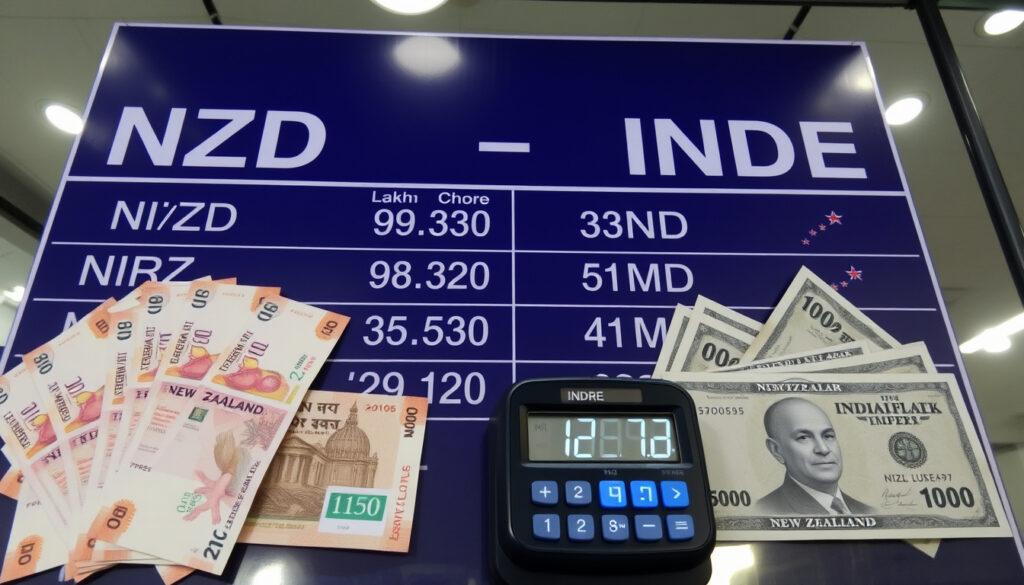
NZD to INR Rate: Lakh & Crore Conversion
The New Zealand dollar is trading near the top of its five-year range against the Indian rupee, making conversions of large Indian units like lakh and crore more valuable than they have been in years. This guide walks through the current mid-market rate, shows exactly what those large Indian units convert to, and explains why the NZD keeps punching above its weight against the rupee.
1 NZD to INR (mid-market): ₹55.30 ·
1 lakh INR to NZD: NZ$1,808 ·
1 crore INR to NZD: NZ$180,800 ·
100 NZD to INR: ₹5,530 ·
500 NZD to INR: ₹27,650 ·
1,000 NZD to INR: ₹55,300
Quick snapshot
- 1 NZD = ₹55.30 at the mid‑market rate (XE (currency data provider))
- 1 lakh = 100,000; 1 crore = 10,000,000 (Encyclopaedia Britannica (reference publisher))
- The NZD is influenced by RBNZ interest‑rate decisions and commodity prices (XE (currency data provider))
- Exact future exchange‑rate movements are uncertain
- Specific fees for each transfer service vary by amount and payment method
- On 2026‑01‑07, 1 NZD = 52.11 INR (Wise (money‑transfer service))
- The 5‑year range has been roughly ₹46–₹57 (Wise (historical data))
- RBNZ rate decisions and Indian economic data will drive further moves
- Compare transfer services before sending large sums
Key facts at a glance
The table below summarizes the key conversion figures and historical range.
| Label | Value |
|---|---|
| Mid‑market rate) | 1 NZD = ₹55.2987 |
| 1 lakh INR to NZD | NZ$1,808.32 |
| 1 crore INR to NZD | NZ$180,832 |
| 100 NZD to INR | ₹5,529.87 |
| 5‑year NZD/INR high | ₹57.00 (approx.) |
| 5‑year NZD/INR low | ₹46.00 (approx.) |
The pattern: the NZD has traded in a roughly ₹11 range over five years, meaning today’s rate sits near the top of its historical band.
How much NZD is 1 lakh?
Conversion formula for 1 lakh INR to NZD
One lakh equals 100,000 Indian rupees (Encyclopaedia Britannica (reference publisher)). To convert to New Zealand dollars, divide the INR amount by the current NZD/INR rate. At the mid‑market rate of 1 NZD = ₹55.30, the calculation is:
- 100,000 ÷ 55.30 = 1,808.32 NZD
The implication: a lakh of rupees buys roughly NZ$1,808 at today’s benchmark – a useful figure for anyone sending a typical remittance from India.
Using the current mid‑market exchange rate
The mid‑market rate – also called the interbank or spot rate – is the wholesale benchmark used by financial institutions (International Money Transfer (guide on exchange rates)). It’s the midpoint between the bid and ask prices in the global foreign‑exchange market (Levro (financial education blog)). Retail customers rarely get this exact rate; banks and transfer services add a markup.
A remitter using a service that offers the mid‑market rate (like Wise) will get roughly 1,808 NZD for 1 lakh INR. A bank offering a 3% markup would deliver only about 1,754 NZD – a difference of 54 NZD.
The implication: using a mid-market rate service can save a meaningful amount on a lakh transfer.
How much is $100 New Zealand in Indian rupees?
Current exchange rate for 100 NZD
At the mid‑market rate of 1 NZD = ₹55.30, 100 New Zealand dollars convert to:
- 100 × 55.30 = ₹5,530
This is the baseline you’ll see on currency converters. For example, XE (currency data provider) shows a similar figure. Wise (money‑transfer service) quotes 1 NZD = 54.60 INR, meaning 100 NZD would be ₹5,460 – slightly lower because of the rate snapshot timing.
Comparison with other amounts (500, 1000 NZD)
Scaling up is straightforward:
- 500 NZD = 500 × 55.30 = ₹27,650
- 1,000 NZD = 1,000 × 55.30 = ₹55,300
The catch: these mid‑market numbers are the best possible rate. A travel‑money provider or bank will quote a different rate that includes a margin.
How much is 1 crore in New Zealand dollars?
Converting 1 crore Indian rupees to NZD
One crore equals 10,000,000 rupees (Encyclopaedia Britannica (reference publisher)). Using the mid‑market rate:
- 10,000,000 ÷ 55.30 = 180,832 NZD
That’s just over 180,000 New Zealand dollars for a crore of rupees – a significant sum used in property transactions, business investments, or large remittances.
Large sum transfer considerations
When transferring a crore, small differences in the exchange rate matter. A rate of 55.00 instead of 55.30 would yield 181,818 NZD – nearly 1,000 NZD extra. Some services offer volume‑based discounts or negotiate a better rate for large transfers (Monito (comparison service)). Always check the mid‑market rate first and then compare the final offer from your provider.
A person sending 1 crore INR to New Zealand for a property deposit could lose or gain thousands of NZD depending on the rate they lock in. The difference between a bank’s rate and the mid‑market rate can easily exceed 5,000 NZD on a crore.
The implication: for a crore transfer, the difference between market rates can be thousands of dollars.
Why is NZD strong?
Factors driving New Zealand dollar strength
The New Zealand dollar has traded above 50 INR for most of the past five years, and several structural factors explain why:
- Interest rates: The Reserve Bank of New Zealand (RBNZ) has maintained relatively high interest rates compared to the Reserve Bank of India (RBNZ (central bank)). Higher rates attract foreign capital, boosting demand for NZD.
- Commodity exports: New Zealand is a major exporter of dairy, meat, and wool. Strong global demand, especially from China and India, supports the currency (Investing.com (financial data platform)).
- Economic stability: Low unemployment, a stable political system, and sound fiscal management make the NZD a relatively safe currency in the Asia‑Pacific region.
Comparison with other major currencies
The NZD behaves similarly to the Australian dollar – both are commodity‑linked and interest‑rate‑sensitive. However, the NZD tends to weaken during global risk‑off episodes as investors move to safe havens like the US dollar. The pattern is clear: the NZD is strong when the global economy is growing, but vulnerable when fear spikes.
The trade‑off: a strong NZD benefits New Zealanders sending money abroad or buying imports, but it hurts exporters by making their goods more expensive in foreign markets.
What is the NZ dollar to Indian rupee rate today?
Live mid‑market rate for NZD/INR
As of the latest available data, the mid‑market rate is approximately 1 NZD = 54.70–55.30 INR, depending on the source. XE (currency data provider) shows 54.6977, Wise (money‑transfer service) shows 54.60, and MyCurrencyTransfer (comparison tool) shows 54.5935. Rates update minute‑by‑minute during market hours.
Where to find the best exchange rate for your transfer
The mid‑market rate is the starting point. Banks and transfer services add a markup, so the effective rate you get is lower. The table below compares three services for the same NZD amount:
Three services, one pattern: the closer the rate is to the mid‑market, the less you pay in hidden fees.
| Service | Rate (1 NZD to INR) | Source |
|---|---|---|
| XE | 54.6977 | XE (currency data provider) |
| Wise | 54.60 | Wise (money‑transfer service) |
| MyCurrencyTransfer | 54.5935 | MyCurrencyTransfer (comparison tool) |
The implication: Wise and MyCurrencyTransfer hover near the mid‑market, while XE’s rate is similarly competitive. The real difference comes from the transfer fee each service charges.
For a live rate, check the Reserve Bank of India (central bank) reference rates or the Reserve Bank of New Zealand (central bank) daily data. Both are official sources that publish rates for institutional use.
“The mid‑market rate is the midpoint between the buy and sell prices in global currency markets – it’s the wholesale benchmark, not a retail price.”
— XE currency analyst (currency data provider)
“We offer the real mid‑market rate with a low, upfront fee – so you see exactly what you’ll get before you send.”
— Wise (money‑transfer service)
For Indians sending money to New Zealand or New Zealanders remitting to India, the choice of transfer service directly affects how much lands in the recipient’s account. The mid‑market rate is the benchmark; the service you pick determines the gap.
For someone sending 1 lakh INR to New Zealand, using a service that offers the mid‑market rate (like Wise) vs a bank that adds a 3% markup means a difference of roughly 54 NZD. Over multiple transfers, that adds up.
Frequently asked questions
How do I transfer NZD to INR with the lowest fee?
Compare services like Wise, XE Money Transfer, and Western Union. Wise typically offers the lowest fee for smaller amounts, while XE may be better for larger sums. Check the mid‑market rate first and use a comparison tool like Monito.
What is the difference between mid‑market rate and bank rate?
The mid‑market rate is the wholesale benchmark used by financial institutions. Banks add a markup (typically 2–5%) to make a profit, so the bank rate is less favourable.
Can I lock in an exchange rate for a future transfer?
Yes, some services offer forward contracts that fix the rate for a future date. This is useful for large or planned transfers. Check with your bank or a specialist currency broker.
How often do NZD/INR exchange rates update?
Rates update continuously during market hours (Monday to Friday, 24 hours in the forex market). Weekend quotes are typically based on Friday’s close.
Is it better to exchange currency in New Zealand or India?
It depends on fees and convenience. Often, using a digital transfer service is cheaper than exchanging cash at an airport or bank. Compare the effective rate (including fees) for both options.
What is the forecast for NZD/INR over the next year?
Forecasts vary. Analysts point to RBNZ interest rate decisions, Indian economic growth, and global commodity prices as key drivers. No prediction is certain, but the mid‑market rate is likely to stay in the ₹50–₹57 range.
What documents do I need for a large remittance to India?
For amounts above a certain threshold, Indian banks require a Form A2 (for outward remittances) and PAN card details. For inward remittances to New Zealand, you may need to provide proof of source of funds for large sums.
For anyone sending money between New Zealand and India, the NZ Dollar to Peso guide and 1 AUD to NZD article offer additional context on currency dynamics in the region.
More related posts
 When is Anzac Day 2025? Date, Traditions & Public Holiday Guide
 Holiday Packages from NZ – Cheap, Family & All-Inclusive Deals
 How to Stop Coughing: Fast Remedies and When to See a Doctor
 Is Lipton Peach Iced Tea Discontinued? Prank Truth
 Adam Brody Movies and TV Shows: The Complete Guide
 What Is an MD5 Checksum? How It Works & Why Avoid It
 Korean Fried Chicken Recipe: Get the Crispy Secret | Step-by-Step
 Things to Do in Takaka: Top Attractions & Activities
